
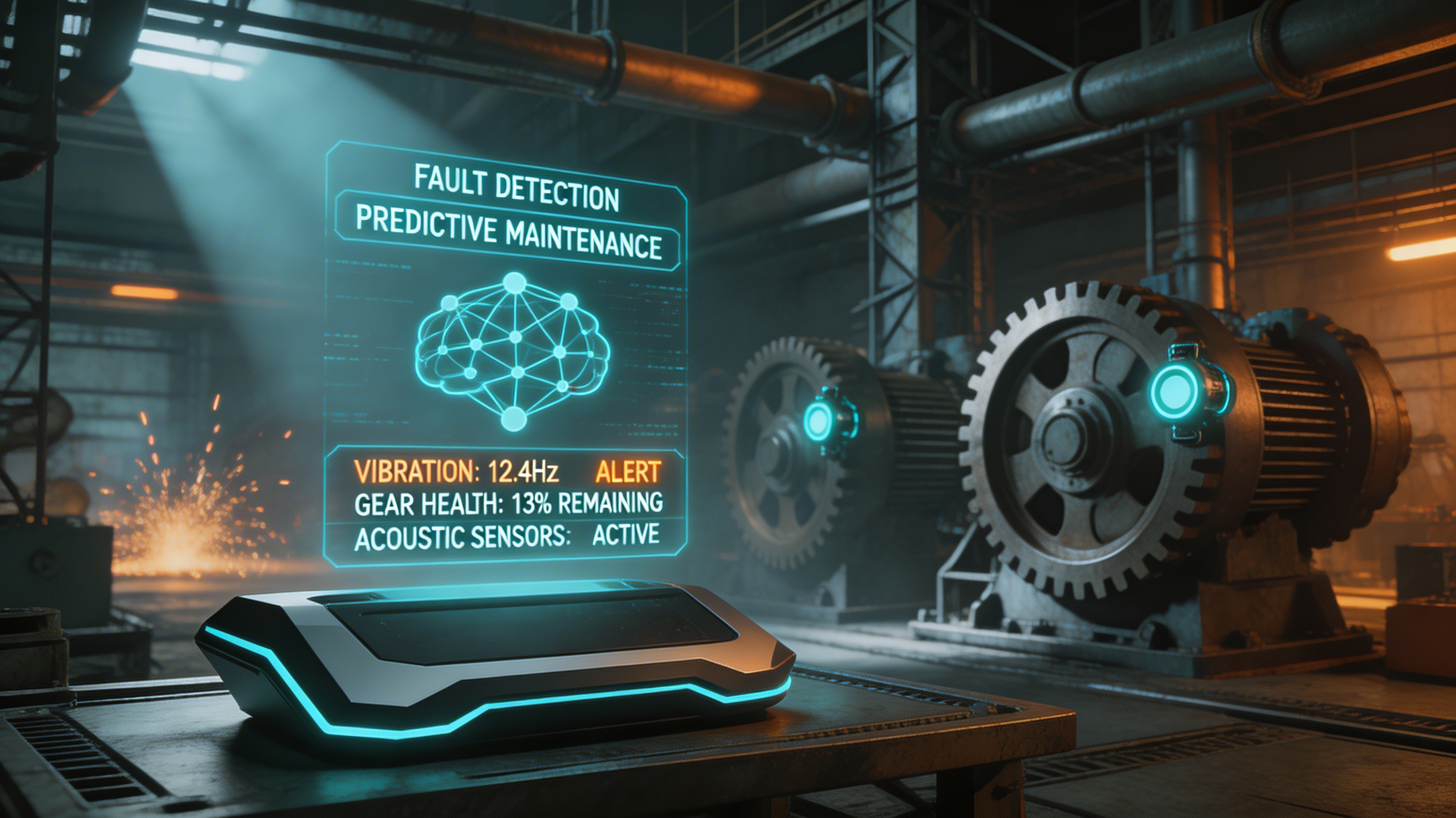
In 2026, smart manufacturing and equipment predictive maintenance have deeply penetrated industrial production workflows. Industrial offline monitoring, production anomaly detection, intelligent industrial auscultation, and equipment fault early warning have become core requirements for manufacturing, power, energy, and equipment industries. Guangzhou SIZheng Technology has launched the SZ-EC-10 AI Edge Computing Terminal — a breakthrough product addressing critical pain points where traditional cloud-dependent devices fail.
The SZ-EC-10 AI Edge Computing Terminal is specifically designed for industrial smart manufacturing, predictive maintenance, and equipment health management scenarios. Its core value lies in pure offline AI inference — all acoustic signal collection, voiceprint feature extraction, fault diagnosis analysis, and warning output are completed locally, with low response latency and high stability, enabling 7×24 hour uninterrupted online monitoring. This makes it ideal for welding shop floor environments where network connectivity may be limited or unreliable.
"Our SZ-EC-10 terminal breaks the limitations of traditional monitoring equipment, integrating acoustic collection, AI analysis, edge computing, alarm linkage, and data management into one complete industrial offline intelligent auscultation solution — truly achieving 'hear clearly, identify accurately, use stably, work offline'." — SIZheng Technology Product Team
Seven Technical Breakthroughs
Key innovations of the SZ-EC-10 include:
- Edge Real-Time AI Diagnosis: Pure offline operation with ≤1 second fault response, no cloud dependency — perfect for remote substations, wind turbines, underground pipelines, unmanned stations
- High-Precision Voiceprint Algorithm: ≥95% accuracy in strong noise environments for bearing, gear, rotor, and structural faults
- Multi-Channel Acoustic Collection: 4-channel industrial Line-in audio synchronous collection with 4 aviation plug sensor interfaces
- Industrial-Grade Hardware: Metal housing, -10°C to +60°C wide temperature range, ≤15W low power, MTBF≥30000 hours
- Rich Interfaces: Gigabit Ethernet, RS485, 4-channel DO alarm output, USB3.0, supporting MQTT, Modbus TCP/RTU, HTTP/HTTPS protocols
- Data Traceability: Abnormal sound segment auto-storage, fault log local circular storage ≥1 year for predictive maintenance analysis
- Easy Deployment: Wall-mount and standard rail installation, one-click sample import, model adaptive learning, no professional debugging required
Technical Specifications
The terminal features a high-performance industrial AI processor with ≥6 TOPS computing power, 4GB LPDDR4 memory, and 32GB eMMC storage. Audio specifications include 4×Line-in inputs with 16-bit sampling precision, signal-to-noise ratio ≥60dB, and flexible sampling rates of 16/48/96 kHz. The device operates in temperatures from -10°C to +60°C with power consumption ≤15W and dimensions of 167×130×33mm in a metal industrial-grade housing with IP30 protection rating.
The terminal covers over 90% of common industrial faults including bearing faults (wear, pitting, cracking, fatigue damage, looseness), gear faults (broken teeth, wear, poor meshing, tooth surface damage), rotor faults (imbalance, misalignment, shaft bending), structural faults (base looseness, housing resonance, friction scraping), and operating anomalies (overload, stuck rotation, no-load abnormality, howling).
Application Scenarios for Welding Operations
For welding equipment manufacturers and fabrication shops, the SZ-EC-10 offers significant value in monitoring welding power sources, wire feeders, cooling systems, and positioners. The acoustic sensors can detect early signs of bearing wear in cooling fans, gear degradation in wire feed mechanisms, and structural resonances that indicate loose components or mounting issues. With its offline capability, the system works reliably even in remote field welding operations where network infrastructure is limited.
The integration with PLC, SCADA, and MES systems via standard protocols means welding operations can incorporate the SZ-EC-10 into existing automation infrastructure without major system redesigns. Fault data stored locally for up to one year enables weld shop managers to analyze trends, identify recurring issues, and schedule preventive maintenance before equipment failures disrupt production.
"Industrial acoustic monitoring represents a paradigm shift for welding equipment health management. Early detection of bearing and gear faults in power sources and feeders can prevent costly unplanned downtime and extend equipment service life significantly." — Industrial Equipment Analysis, Gongkong Feature Article