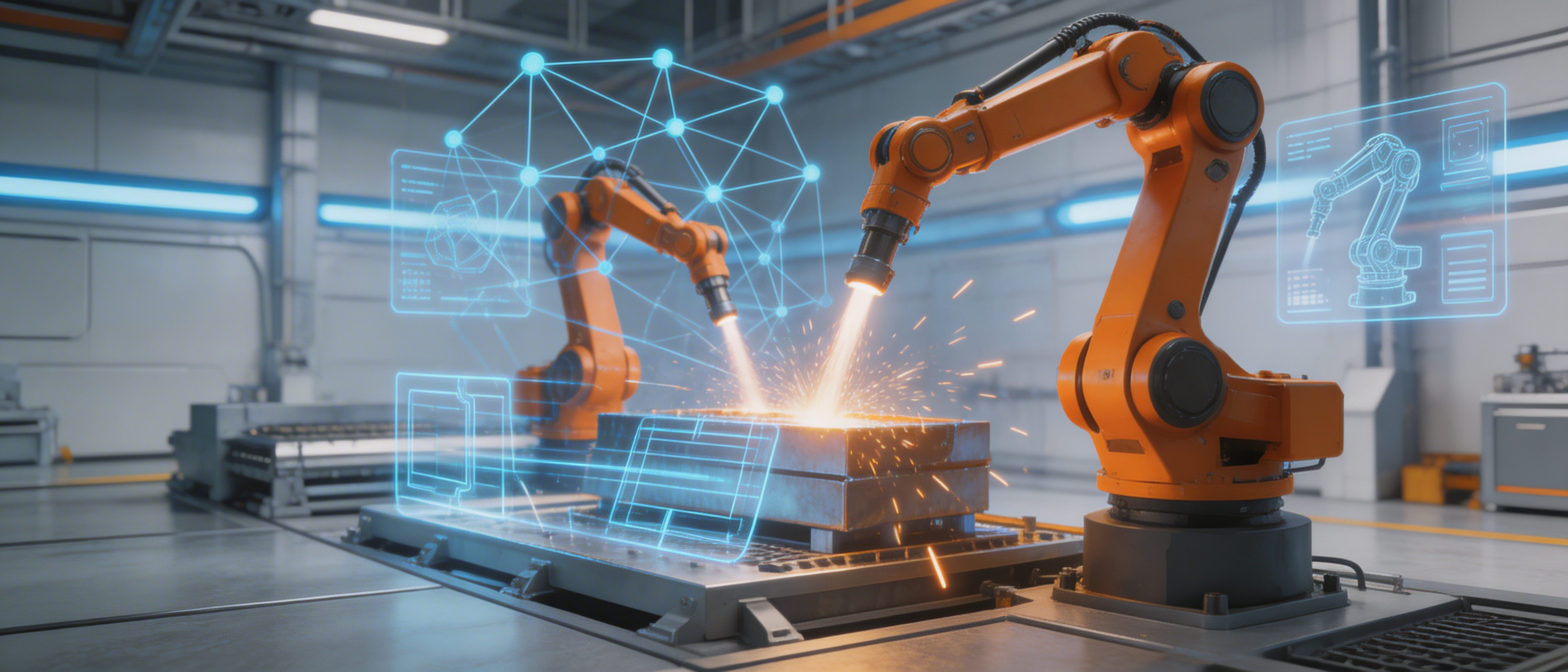
Valk Welding has unveiled a revolutionary AI-driven product recognition system called "AI Driven Similarities" that transforms how robotic welding cells handle product variations. This cutting-edge technology automatically recognizes product geometries and links them to the optimal welding parameters, eliminating the need for manual programming when new products enter the production line.
The system uses advanced machine vision and neural network algorithms to identify geometric patterns in workpieces. When a new product enters the welding cell, the AI analyzes its shape, compares it against a database of previously welded components, and automatically selects the most appropriate welding program — all without human intervention. This capability dramatically reduces changeover time and enables manufacturers to handle high-mix, low-volume production with unprecedented efficiency.
"AI Driven Similarities represents a paradigm shift in robotic welding automation. By eliminating manual programming, we're enabling our customers to achieve true flexibility in their production — switching between products instantly without costly setup time or specialized programming expertise." — Valk Welding Technology Development Team
How AI-Driven Product Recognition Works
The technology operates through several sophisticated stages:
- Geometric Pattern Analysis: Machine vision captures and analyzes the 3D geometry of incoming workpieces, creating a digital fingerprint of each product
- Similarity Matching: Neural network algorithms compare the captured geometry against a learned database of known products, identifying the closest match
- Parameter Optimization: The system automatically selects and fine-tunes welding parameters (speed, current, torch angle) based on the matched product type
- Real-time Adaptation: During welding, AI continues monitoring and adjusts parameters dynamically for optimal quality
- Continuous Learning: The system learns from each welding operation, expanding its knowledge base and improving accuracy over time
Industry Applications and Benefits
The technology addresses critical challenges in modern manufacturing environments where product variety continues to increase while batch sizes decrease. Industries benefiting from this innovation include:
"AI Driven Similarities" enables robotic welding cells to handle thousands of product variations without the traditional programming bottleneck. Manufacturers can now respond quickly to customer demands and market changes without the weeks-long setup delays that previously constrained production flexibility.
Today's Global Welding Industry Highlights
April 11, 2026 marks National Welding Month in the United States, with AWS celebrating the 30th anniversary of this industry awareness campaign. The welding industry continues rapid technological advancement across multiple fronts:
- ESAB Acquires EWM GmbH: Major consolidation in European arc welding technology, strengthening ESAB's market position
- Path Robotics in US Shipyards: Huntington Ingalls Industries deploys advanced robotic welding to accelerate shipbuilding
- European Market Growth: Welders market projected at USD 8.49B in 2026, driven by EU Green Deal and offshore wind
- Miller Electric Innovations: Battery-powered TIG welder and ArcCapture weld camera systems launched
- Hyundai AI Humanoids: AI-powered humanoid welding robots trials set for 2026-2027 shipyard deployment
- Laser-Arc Hybrid Expansion: Faster speeds, lower heat input reaching heavier fabrication applications
"The convergence of AI, machine vision, and robotic welding is creating unprecedented opportunities for manufacturing flexibility. Valk Welding's product recognition system exemplifies how intelligent automation can solve the high-mix production challenge that has long constrained robotic welding adoption." — Industry Technology Analysis, April 2026