
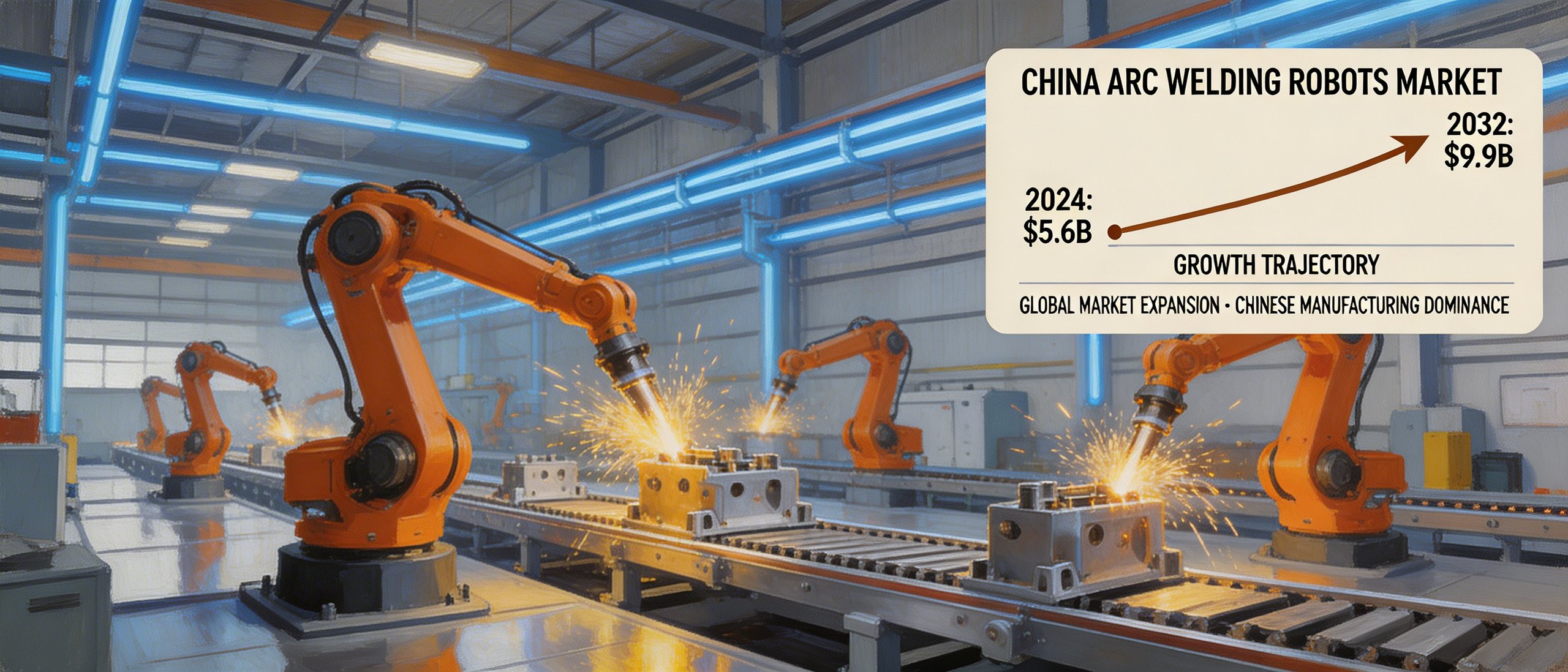
The China arc welding robots market is experiencing significant growth, driven by the country's strong push for industrial automation and advancements in factory manufacturing. According to Mobility Foresights, the market is projected to expand from USD 5.6 billion in 2025 to USD 9.9 billion by 2032, demonstrating a robust Compound Annual Growth Rate (CAGR) of 7.8% during this period. This expansion positions China as a global leader in the adoption and production of industrial robots.
The growth is fueled by multiple factors including rising labor costs and shortages compelling manufacturers to adopt robotic welding solutions, increasing demand from automotive (particularly electric vehicles), construction, heavy equipment, aerospace, electronics, and shipbuilding industries. Government initiatives such as "Made in China 2025" and other smart manufacturing programs actively encourage industrial automation, fostering demand for robotic welding systems.
"China's arc welding robots market growth from $5.6B to $9.9B by 2032 reflects the country's accelerating transformation toward intelligent manufacturing. This 7.8% CAGR signals strong confidence in automation adoption across key industrial sectors." — Mobility Foresights Market Report, April 2026
Key Drivers of Market Expansion
The rapid growth is driven by several converging factors:
- Industrial Automation Push: Increasing need for automation in manufacturing to boost productivity and reduce operational costs
- Labor Shortages: Rising labor costs and workforce constraints compelling manufacturers to adopt robotic solutions
- EV Manufacturing Growth: Expanding electric vehicle production requiring high-quality, consistent welding operations
- Government Support: "Made in China 2025" and smart manufacturing initiatives actively promoting automation
- AI Integration: Artificial intelligence, machine vision, and IoT enhancing operational efficiency and accuracy
China's Industrial Robot Dominance
China is at the forefront of the robotics revolution, with 295,000 new industrial robots installed in 2024, surpassing the combined installations of all other countries globally. In 2023, the industrial robotics intensity in Chinese factories reached 470 robots per 10,000 workers, a 91% increase from 2020. Chinese manufacturers now hold 57% domestic market share, up from just 18% in 2015.
Chinese welding robots are priced 20-40% below Western competitors while achieving 0.02mm precision, making them increasingly competitive in global markets. This pricing advantage combined with quality improvements is accelerating adoption both domestically and for export markets.
Today's Chinese Welding Industry Highlights
April 11, 2026 brings multiple significant developments in China's welding and robotics sector:
- Chinese Industrial Robot Exports Surge 65% Annually: Domestic market share reaches 57%, up from 18% in 2015
- Chinese Welding Robots Priced 20-40% Below Western: Competitive pricing with 0.02mm precision capability
- Global Robotic Welding Market to Hit $20.69B by 2032: Driven by automation needs and welder shortage
- AI Welding Robots Achieve 98% Quality in LNG Shipbuilding: Shanghai shipyard reports 8x efficiency improvement
- "No-Teach" Intelligent Welding at VisionChina 2026: Weijing Intelligence showcases path planning innovation
- China's 15th Five-Year Plan Prioritizes Robotics: Smart manufacturing designated as key development sector
"China's dominance in industrial robotics is reshaping global manufacturing. With 295,000 new robot installations in 2024 alone, exceeding all other countries combined, China is positioning itself as the world's automation powerhouse." — CSIS China Power Analysis, April 2026