
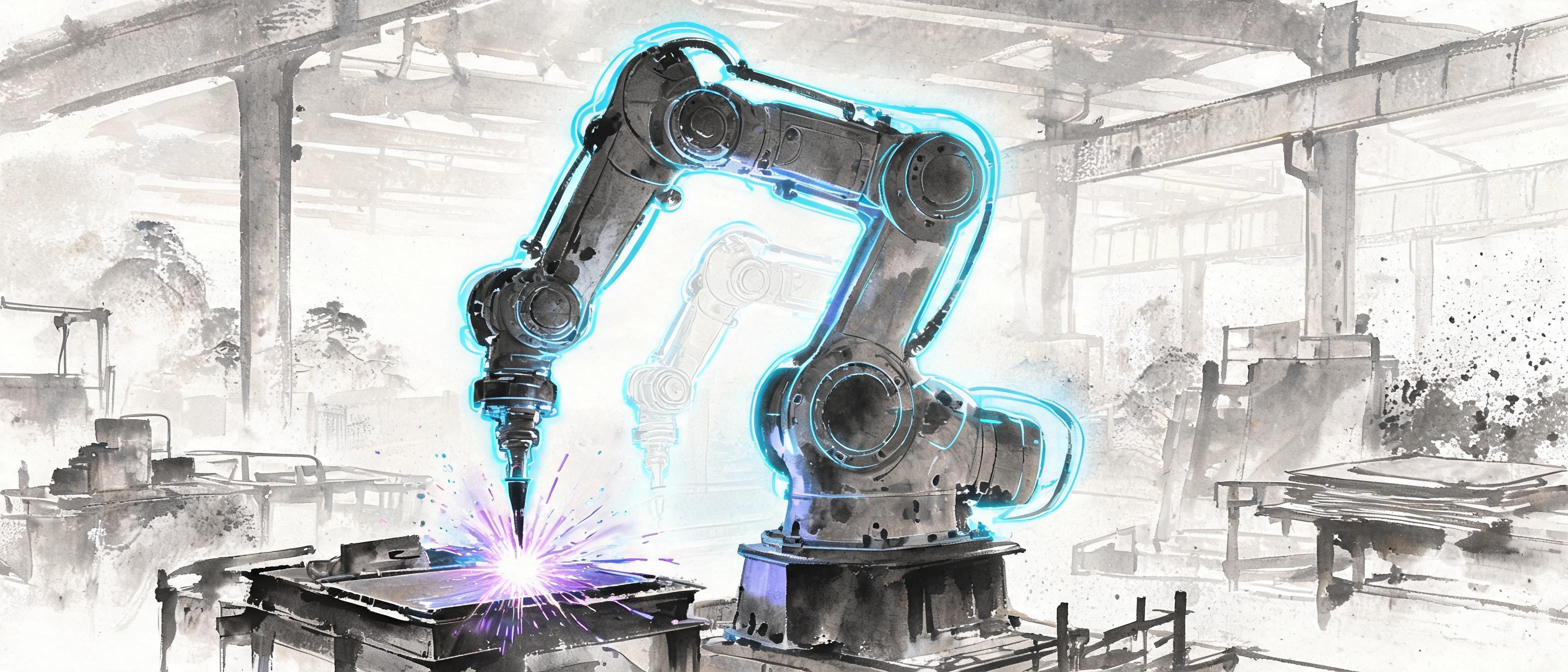
Welding Robots Guide 2026 — Industrial Automation for Modern Fabrication
Welding is one of the oldest applications for industrial robotics — and in 2026, it remains one of the most impactful. The global welder shortage has reached critical levels, with the American Welding Society estimating a deficit of 360,000 welding professionals by 2027. Meanwhile, demand for welded assemblies in automotive, construction, shipbuilding, and energy infrastructure continues to climb. Robotic welding is no longer a competitive advantage; for many fabricators, it is a survival strategy.
This guide covers the current state of robotic welding technology, the leading platforms, and how to evaluate whether your operation is ready for automation.
The State of Robotic Welding in 2026
Robotic welding has evolved significantly from the rigid, teach-pendant-programmed systems of the 2010s. Three trends define the current generation:
Adaptive welding with real-time seam tracking
Modern welding robots use laser vision sensors and through-arc sensing to track weld seams in real-time, adjusting torch position, travel speed, and wire feed dynamically. This means robots can handle parts with variation — stamped components that are slightly different each time, tack-welded assemblies with gaps, fixtures that shift over the course of a production run. The requirement for perfectly fixtured, identical parts has relaxed considerably.
Collaborative welding cobots
Traditional welding robots require safety cages, light curtains, and dedicated cells. Collaborative welding cobots from Yaskawa, Universal Robots, and FANUC can operate in shared spaces with human welders, handling repetitive welds while humans tackle complex joint geometries. This opens robotic welding to small job shops that lack floor space for traditional cells.
Offline programming and digital twins
Programming a welding robot no longer requires an expert with a teach pendant spending hours at the cell. Offline programming software (Octopuz, RoboDK, FANUC ROBOGUIDE) lets engineers program weld paths from CAD files, simulate them in a digital twin, and deploy to the robot — reducing programming time from days to hours.
Leading Welding Robot Platforms
FANUC M-710iC Series
RoboScore: 86.5 / 100 | Price: $75,000-$150,000 (robot only)
The FANUC M-710iC is a six-axis industrial robot designed for arc welding, material handling, and machine tending. With a 50-kg payload and 2,050-mm reach, it handles medium to large welding assemblies with the precision and repeatability that FANUC is known for — 0.04 mm repeatability across the full working envelope.
The M-710iC runs on FANUC's R-30iB Plus controller, which supports iRVision (integrated vision), iRCalibration (automatic TCP calibration), and the ARC Mate welding software package. For production welding where uptime and cycle time are paramount, the M-710iC is the industry default.
Best suited for: High-volume production welding in automotive, heavy equipment, and structural fabrication. Facilities running two or three shifts that need maximum uptime and throughput.
Key strengths:
- 0.04 mm repeatability for consistent, high-quality welds
- Extensive welding process support: MIG, TIG, plasma, laser
- iRVision seam tracking for adaptive welding
- Massive global service network — FANUC has service engineers in every industrial market
- 80,000+ hour MTBF (mean time between failures)
Yaskawa HC10DT Collaborative Welding
RoboScore: 80.2 / 100 | Price: $45,000-$65,000 (robot only)
The Yaskawa HC10DT is a collaborative robot with a 10-kg payload and 1,200-mm reach. While it is a general-purpose cobot, Yaskawa has developed specific welding packages that pair the HC10DT with Fronius, Miller, or Lincoln welding power sources for collaborative MIG welding applications.
The HC10DT's collaborative nature means it can operate without safety fencing in certain risk-assessed configurations. For job shops and small fabricators, this changes the economics dramatically — you do not need to dedicate a 15x15-foot cell to the robot.
Best suited for: Small to mid-size fabrication shops handling mixed products with moderate welding volume. Operations where floor space is limited and the flexibility to redeploy the robot to different tasks is valuable.
Key strengths:
- Collaborative operation without safety fencing (with risk assessment)
- Hand-guided teaching — a welder can physically guide the arm through the weld path
- Compact footprint suitable for job shop environments
- Lower acquisition cost and faster programming
- Dual-use capability: welding, machine tending, material handling
Choosing Between Traditional and Collaborative Welding Robots
The decision depends on your production profile:
| Factor | Traditional (FANUC M-710iC) | Collaborative (Yaskawa HC10DT) |
|---|---|---|
| Production volume | High (1,000+ parts/day) | Low to medium (50-500 parts/day) |
| Part variety | Low to medium | Medium to high |
| Cycle time priority | Critical | Important but flexible |
| Floor space | Dedicated cell required | Can share space with workers |
| Programming | Offline + teach pendant | Hand-guided + offline |
| Welding processes | MIG, TIG, plasma, laser, spot | Primarily MIG |
| Payload | 50 kg | 10 kg |
| Investment | $150K-$400K (full cell) | $65K-$120K (full setup) |
The hybrid approach is increasingly common: traditional robots handle high-volume, repetitive welding on production lines, while cobots tackle short runs, prototypes, and overflow work in flexible cells.
Critical Considerations for Welding Robot Deployment
Fixturing is everything
The quality of your welds depends as much on fixturing as on the robot itself. Even with adaptive seam tracking, consistent part presentation reduces cycle time, improves weld quality, and extends consumable life. Budget 20-30% of your total cell cost for fixturing — it is the most underfunded line item in welding automation projects.
Welding process selection
Not every welding process is equally suited to robotic automation:
- MIG/GMAW is the easiest to automate and the most common robotic welding process. Reliable arc starts, good gap bridging, and forgiving parameter windows.
- TIG/GTAW produces the highest-quality welds but is slower and more sensitive to parameters. Robotic TIG is common in aerospace, medical devices, and high-purity piping.
- Spot welding is dominant in automotive body-in-white operations. Dedicated spot welding robots have integrated servo guns.
- Laser welding is growing rapidly for thin materials and high-speed applications. Requires different safety considerations (laser Class 4).
Welder-to-robot operator transition
Experienced welders make the best robot operators. They understand joint geometry, heat input, and distortion — knowledge that translates directly to programming and troubleshooting welding robots. The most successful automation programs retrain their best welders as robot programmers rather than replacing them.
Integration with upstream and downstream processes
A welding robot achieves maximum value when integrated with part handling automation. Robotic loading, rotating positioners, and conveyor systems keep the torch welding while material handling happens in parallel. Without integration, the robot spends 40-60% of its cycle idle while a human loads and unloads parts.
Safety Requirements
Welding robots introduce specific safety considerations beyond standard industrial robot safety:
- Arc flash protection: Welding screens and auto-darkening curtains for any personnel in the area
- Fume extraction: Robotic welding generates the same fumes as manual welding — proper ventilation and extraction are non-negotiable
- Fire suppression: Spark and spatter management, especially in cells with flammable materials nearby
- Electrical safety: High-current welding circuits require proper grounding and isolation
For collaborative welding cobots, a thorough risk assessment per ISO/TS 15066 is mandatory before operating without fencing.
Frequently Asked Questions
What is the ROI timeline for a welding robot?
Most welding robot installations achieve full ROI in 12-18 months for high-volume applications and 18-30 months for job shop environments. The primary savings come from increased throughput (a robot welds 85-95% of the time vs. 25-35% for a manual welder), reduced rework, and lower labor costs. A single welding robot typically replaces 2-3 manual welding stations in terms of output.
Can a welding robot handle custom and short-run work?
Yes, particularly collaborative welding cobots like the Yaskawa HC10DT. Hand-guided programming lets you teach a new weld path in minutes rather than hours. Offline programming from CAD files further reduces setup time. However, for true one-off work, manual welding remains more efficient — automation shines when you run the same part at least 10-20 times.
Do I need to hire a robot programmer for a welding robot?
Not necessarily. Modern welding cobots support hand-guided teaching that experienced welders can learn in days. For traditional industrial robots like the FANUC M-710iC, the learning curve is steeper — expect 40-80 hours of training for basic programming. Many integrators offer ongoing programming support as part of their service contracts.
What welding quality can I expect from a robot compared to a skilled human welder?
A properly programmed welding robot produces more consistent welds than a human — every bead is identical in terms of travel speed, wire feed, and torch angle. The best human welders can still outperform robots on complex, irregular joints that require real-time judgment. For straight seams, fillet welds, and repetitive joints, robots produce higher average quality with near-zero variation.
How much floor space does a welding robot cell require?
A traditional welding robot cell with safety fencing requires 150-250 sq ft depending on part size and material handling configuration. Collaborative welding setups like the Yaskawa HC10DT can operate in as little as 50-80 sq ft since they do not require fencing (with proper risk assessment). Multi-robot cells and systems with rotating positioners may need 300-500 sq ft.