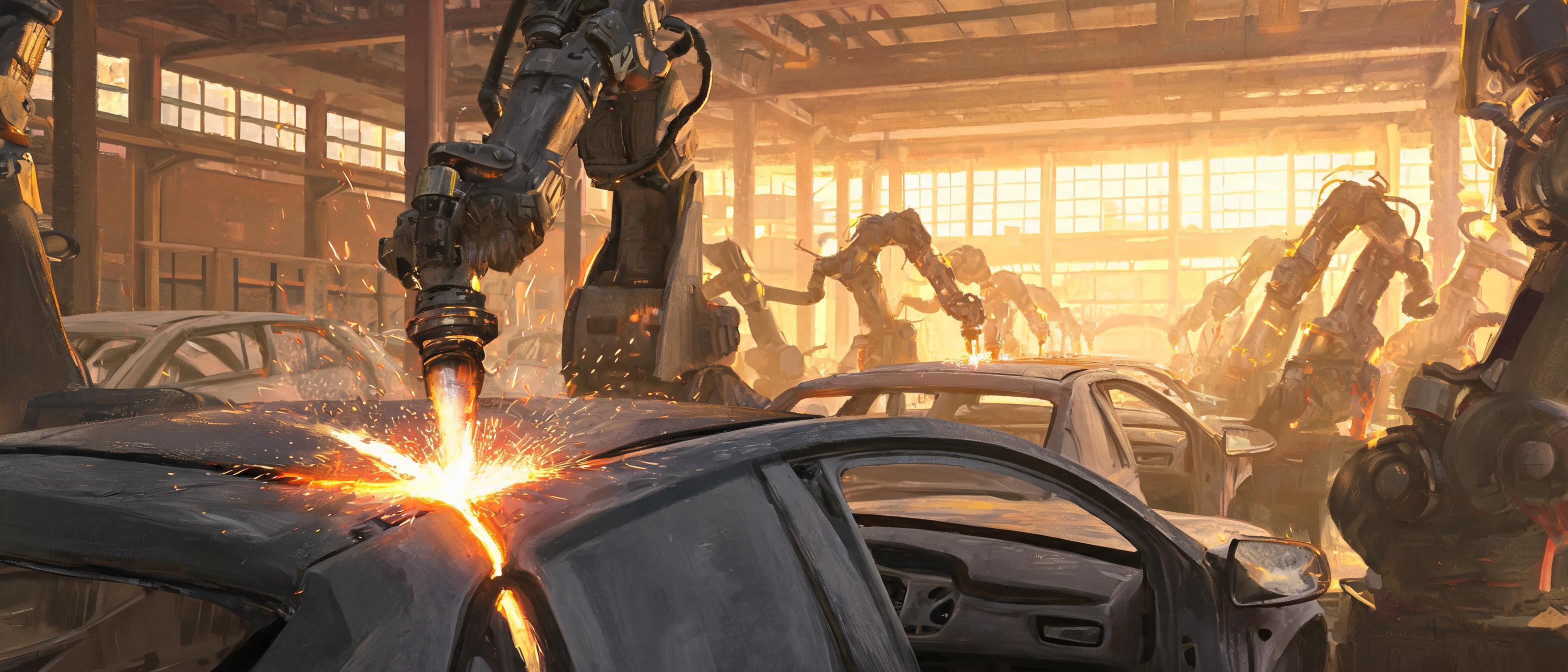
Robotic welding is entering a new phase. For years, manufacturers have used robots to improve speed, repeatability, and output in well-controlled production environments. Now the conversation is shifting toward something more ambitious: welding systems that can recognize real-world variation and adapt during production.
According to FSM Direct's July 2026 coverage, Novarc and Yaskawa are advancing AI-powered autonomous welding automation by integrating Novarc's NovAI Autonomy with Yaskawa six-axis robots. Yaskawa Motoman also lists the partnership in its June 2026 news releases. For fabrication shops watching the market, this is a signal that AI welding is moving from isolated technology demonstrations toward broader robotic platform integration.
For brands such as GNIWELDER, the development matters because it reinforces a larger trend: welding buyers are no longer evaluating only machines. They are evaluating complete production systems that combine welding performance, robotics, data, service, and long-term scalability.
Traditional robotic welding depends on repeatability. If the part is consistent, the fixture is accurate, and the program is well prepared, the robot can deliver excellent results. But many fabrication shops do not operate in perfect conditions. Gaps change. Tack welds vary. Fit-up is not always ideal. Operators may need to adjust settings when parts arrive differently than expected.
AI-powered welding systems are being developed to address that gap between programmed motion and real production variation. Instead of simply following a fixed path, adaptive systems can use sensors, vision, and process intelligence to respond to changing joint conditions.
This does not remove the need for weld procedures, qualified personnel, or good fixturing. It does, however, make robotic welding more practical for shops that handle variation. That is where the market opportunity becomes larger than automotive-style automation.
The Novarc and Yaskawa announcement is important because it connects welding intelligence with an established robot platform. According to OEM Magazine's June 2026 report, the memorandum of understanding is intended to bring Novarc's AI-powered adaptive welding intelligence platform to Yaskawa's robotic platform.
That type of partnership shows where the industry is heading. Welding automation is becoming less about a single product and more about a connected stack: robot arm, welding power source, sensors, software, data, and service support.
For a manufacturer evaluating GNIWELDER robotic welding solutions, this is the right mindset. The question should not be "Which robot is fastest?" The better question is: "Which system can help us reduce rework, stabilize weld quality, and scale production without overwhelming our team?"
AI welding can sound advanced, but buyers should keep the evaluation grounded. The system should solve measurable shop-floor problems.
Useful questions include: Can it handle joint variation? Can it reduce manual rework? Can operators understand the interface? Can the system store useful weld data? Can it integrate with current production flow? Can the supplier support commissioning and training?
GNIWELDER can be positioned as a practical partner in this transition. A shop may first upgrade manual or semi-automatic welding equipment, then standardize parameters, then introduce robotic welding for repeatable parts, and eventually evaluate more adaptive or data-connected welding workflows.
Large manufacturers may have automation engineers, fixture specialists, and internal robotics teams. Mid-sized fabricators often do not. They need systems that are easier to deploy, easier to maintain, and easier to justify financially.
That is why AI-powered robotic welding partnerships are worth watching. If adaptive welding becomes more accessible through familiar robot platforms, more shops may be able to adopt automation without rebuilding their entire process.
The winners will be the companies that treat AI as a production tool, not a marketing phrase. For GNIWELDER, the strongest content position is clear: help manufacturers build a practical roadmap from stable welding equipment to robotic welding and, where appropriate, intelligent automation.
AI welding is not a replacement for welding expertise. It is a way to extend that expertise across more parts, more shifts, and more demanding production schedules. As partnerships like Novarc and Yaskawa move forward, welding buyers should prepare for a future where automation is judged not only by motion, but by intelligence, adaptability, and real shop-floor results.