
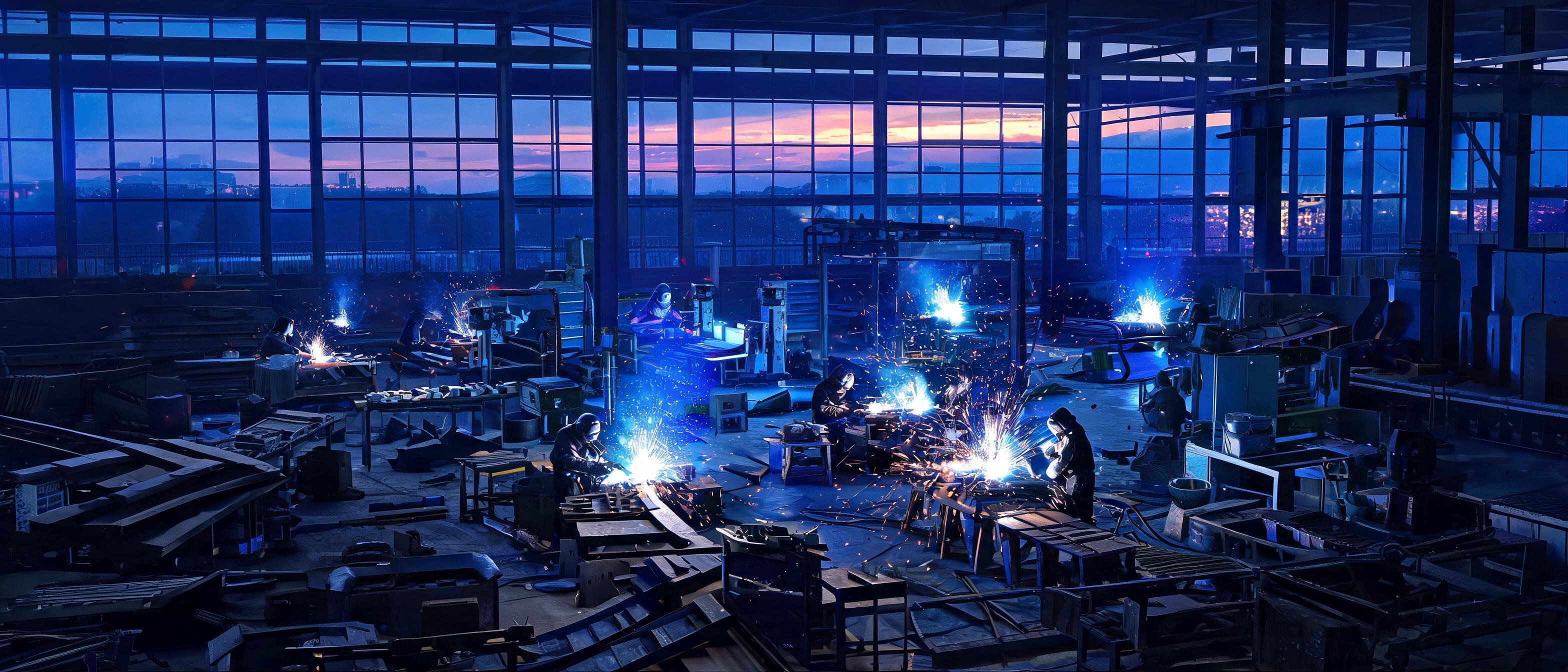
Welding technology has undergone revolutionary changes in 2026, with innovations like robotic automation, laser precision systems, and AI-driven quality control reshaping how manufacturers approach metal joining. Motorcity Metal Fab, a leading provider of welding and fabrication services in Taylor, Michigan, has witnessed firsthand how these advancements in welding technology improve productivity for automotive, aerospace, and industrial clients across the Detroit metro area. From robots doing the welding to lasers and ultrasonic methods, these advancements are changing the game. They make welding services in Detroit faster, safer, and better.
- New welding technologies are making the process faster and more efficient while reducing material waste and rework costs
- Robotic welding systems offer many benefits, but also have some challenges for small and medium manufacturers
- Laser and ultrasonic welding provide high-quality results for different uses in aerospace, automotive, and medical device manufacturing
- Automation is key to making industrial fabrication services safer and more productive through reduced human error and consistent quality
- Advanced materials and quality control are crucial for top-notch welding in precision manufacturing applications
The latest welding technology in 2026 includes cobots (collaborative robots), AI-powered weld monitoring systems, laser hybrid welding, and digital twin simulation software. These innovations enable manufacturers to achieve precision that was impossible just five years ago. Unlike traditional welding methods that rely heavily on operator skill, modern systems use sensors and machine learning algorithms to automatically adjust parameters in real-time, ensuring consistent weld quality across thousands of parts.
For Michigan manufacturers, these technologies represent a competitive advantage in industries where tolerances are measured in microns. Companies investing in CNC machining and advanced welding capabilities can now deliver components that meet aerospace and medical device specifications without extensive manual rework.
Robotic welding systems have become increasingly sophisticated, offering enhanced precision, speed, and flexibility. This section explores the latest innovations in robotic welding technology, including advancements in programming, sensor integration, and adaptive control.
Robotic welding has been a game-changer in various industries, significantly boosting productivity by automating production lines and ensuring consistent quality. One notable example is Smoker Craft, which specializes in the production of aluminum boats. They adopted a robotic tube-welding system about two years ago to automate their entire pontoon production. This shift has led to remarkable improvements in both speed and precision, reducing the risks associated with manual welding.
The primary advantages of robotic welding systems include:
- Consistent weld quality across all production runs
- Reduced labor costs and workplace injuries
- 24/7 operation capability for high-volume manufacturing
- Precise repeatability for complex geometries
- Integration with CAD designing and CAM manufacturing workflows
Despite its many benefits, implementing robotic systems for metal fabrication services comes with challenges. The initial investment in equipment and training can be substantial. Additionally, integrating these systems into existing production lines often requires significant modifications. Companies must also consider the ongoing maintenance and potential technical issues that could arise, which may require specialized skills to address. For small manufacturers in Michigan, the ROI timeline can extend 18-24 months, making financing and workflow planning critical to successful adoption.
The future of robotic welding looks promising, with advancements in artificial intelligence and machine learning paving the way for even more sophisticated systems. These technologies are making robotic welding arms more flexible and easier to program. Flexible automation solutions, such as welding cobots, are also expected to become more prevalent, making welding more accessible to a wider group of operators with less training. By 2027, industry analysts predict that over 60% of automotive tier-1 suppliers will use collaborative welding robots.
Laser welding uses a focused laser beam to melt and join metals with minimal heat-affected zones, while MIG welding employs a consumable wire electrode and shielding gas for robust structural joints. The choice between laser and MIG welding depends on application requirements: laser excels in thin materials and precision work (aerospace, electronics), while MIG remains ideal for thicker structural steel and heavy fabrication.
Laser welding has many benefits over older methods. The focused laser beam creates a small, controlled heat area. This means less risk of bending or damaging nearby materials. The process is also very efficient and accurate. Additional laser welding benefits include faster cycle times (up to 10x faster than TIG), deeper penetration in single passes, and the ability to weld dissimilar metals like aluminum to steel.
In aerospace, laser welding is used to join parts with high strength and little bending. The medical field uses laser welding to make clean, exact welds for tools. The car industry uses it for repairs and making parts, which improves the quality and strength of the products. Michigan's automotive supply chain has increasingly adopted laser welding for battery enclosures in electric vehicles, where precision and thermal control are critical.
Ultrasonic welding is a solid-state process that uses high-frequency vibration energy to join materials. Unlike traditional methods, it doesn't melt the materials but brings them into a plastic state to form a bond. Ultrasonic welding operates at frequencies between 15-70 kHz, creating molecular-level bonding without introducing heat distortion.
When compared to traditional welding methods, ultrasonic welding offers several advantages:
- Reduced Distortion: The process minimizes heat input, thereby reducing the risk of warping and distortion.
- Speed: Ultrasonic welding is faster, making it suitable for high-volume production with cycle times under 2 seconds.
- Energy Efficiency: It consumes less energy compared to conventional welding techniques — up to 80% energy savings over resistance welding.
- Versatility: Capable of joining a wide range of materials, including metals and plastics.
Key industries using ultrasonic welding include automotive (wiring harnesses, EV battery terminals), electronics (circuit connections, micro-welding), medical (contamination-free device assembly), and aerospace (lightweight alloy assemblies).
Welding automation reduces costs through decreased labor expenses, minimized rework, improved material utilization, and faster production cycles. Automated welding systems eliminate costly human errors that lead to scrapped parts, while increasing throughput by 300-500% compared to manual processes. For a typical Michigan job shop, automation can reduce per-part welding costs by 40-60% once initial equipment investments are amortized.
Key automation technologies include robotic welding cells, cobot systems for small batch runs, and AI-powered weld monitoring software that predicts defects before they occur.
The integration of digital technologies in welding has enabled the collection and analysis of real-time data, providing valuable insights for process optimization.
Weld data monitoring and storage provide a wealth of information that can be used to engineer better products, develop enhanced welding parameters, and streamline the welding process for efficiency. Data about the performance of welding machines can be used to identify any potential maintenance issues before they cause a work stoppage. Modern welding power sources now transmit data via IoT protocols, enabling cloud-based analytics and predictive maintenance scheduling.
Machine learning algorithms can now predict weld defects with 94% accuracy, allowing real-time parameter adjustments that prevent scrap before it happens. Sensor technologies include thermal imaging cameras, acoustic emission sensors for crack detection, and high-speed cameras that capture arc behavior at 10,000 frames per second.
Modern welding equipment includes features like real-time monitoring and automatic shut-off systems to prevent accidents. Collaborative robots remove workers from the direct vicinity of welding arcs, improving welder and worker safety while maintaining high productivity levels.