
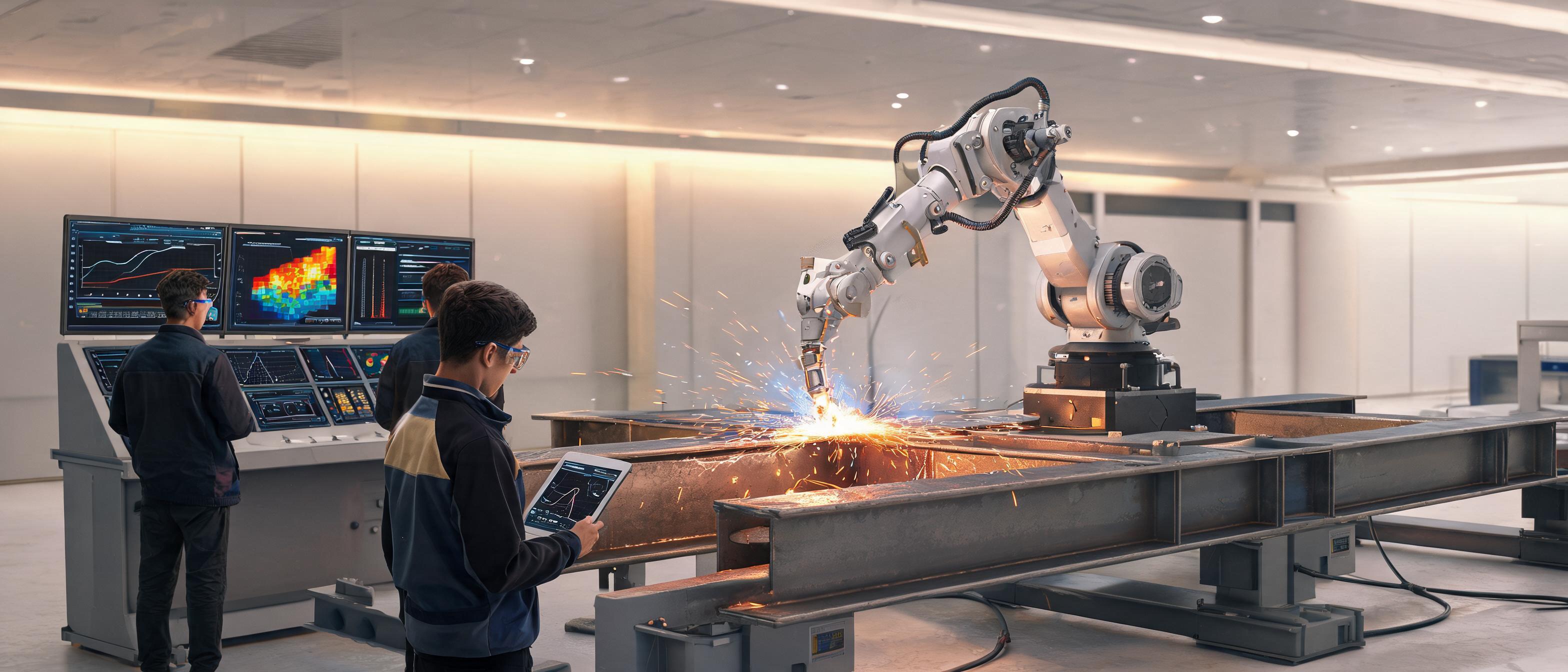
Welding is increasingly becoming a data-intensive discipline. As automation, artificial intelligence, and digital manufacturing reshape industry expectations, welding monitoring is moving from a quality-assurance accessory into a strategic enabler of consistency, productivity, and autonomous production.
Xiris points to a rapidly growing market for real-time welding monitoring systems. The company cites industry estimates valuing the market at nearly USD 1.76 billion in 2025 and projecting growth to more than USD 4.14 billion by 2035, an 8.6% compound annual growth rate. That forecast reflects a broader shift: fabricators are no longer satisfied with recording whether a weld was made; they want continuous evidence of how it was made and whether process conditions stayed within control.
The next generation of monitoring is not simply about clearer camera images. Machine-vision systems are becoming intelligent sensor suites capable of interpreting weld-pool behavior, arc stability, spatter, joint position, and morphology in real time.
High-speed imaging and intelligent filters allow engineers to observe molten-pool transitions and spatter events that happen too quickly for the human eye. When those images are paired with deep-learning models, the system can analyze visual and thermal patterns to detect defects, predict outcomes, and provide feedback for process control.
Xiris says its cameras and WeldStudio software already support applications where deep-learning models analyze the weld pool, monitor arc stability, measure heat distribution, and perform blob analysis or weld-pool segmentation. The result is a transition from visualization — showing operators what is happening — to interpretation — helping machines decide what the visual data means.
AI is also expanding welding monitoring beyond defect detection into predictive quality control. Thermal and optical cameras can feed digital twins and process models, allowing manufacturers to simulate welding outcomes before they occur.
The article highlights thermal imaging, including SWIR thermal cameras, as a way to map temperatures across weld pools and heat-affected zones. That data can be used to measure cooling rates, interpass temperatures, and thermal stability during multi-pass welding or additive manufacturing. Instead of discovering defects after fabrication, operators and automation systems can anticipate conditions likely to cause them and adjust parameters earlier.
Robotic welding is one of the clearest use cases for advanced monitoring. Modern robotic cells and cobots depend on real-time feedback loops in which camera systems guide torch positioning, arc parameters, and defect response.
AI-enabled welding robots can detect anomalies and adjust behavior autonomously, reducing rework and improving throughput. Xiris reports that manufacturers using HDR cameras in robotic cells have seen more consistent bead profiles, reduced spatter, and fewer costly reworks. Adding thermal monitoring gives the robot both visual and thermal awareness of the process, supporting more repeatable welding even when part conditions vary.
Monitoring technology is also changing welding education. New welders need more than torch technique; they increasingly need data literacy. Training centers and universities are using camera systems to show students weld-pool dynamics, heat distribution, metal transfer, and defect formation in ways that traditional hood-time observation cannot.
That educational shift matters because future welding teams will be expected to understand real-time video, sensor dashboards, AI-assisted diagnostics, and process analytics as routine parts of the job.
The article’s central argument is that welding monitoring is becoming multi-layered: real-time systems are becoming standard, machine vision is shifting from observation to interpretation, predictive control is moving closer to production, and robotics is relying on monitoring for adaptive behavior.
For fabricators, the practical implication is that weld cameras and process sensors are no longer just troubleshooting tools. They are becoming core infrastructure for automated quality, robotic flexibility, workforce training, and measurable process improvement.