
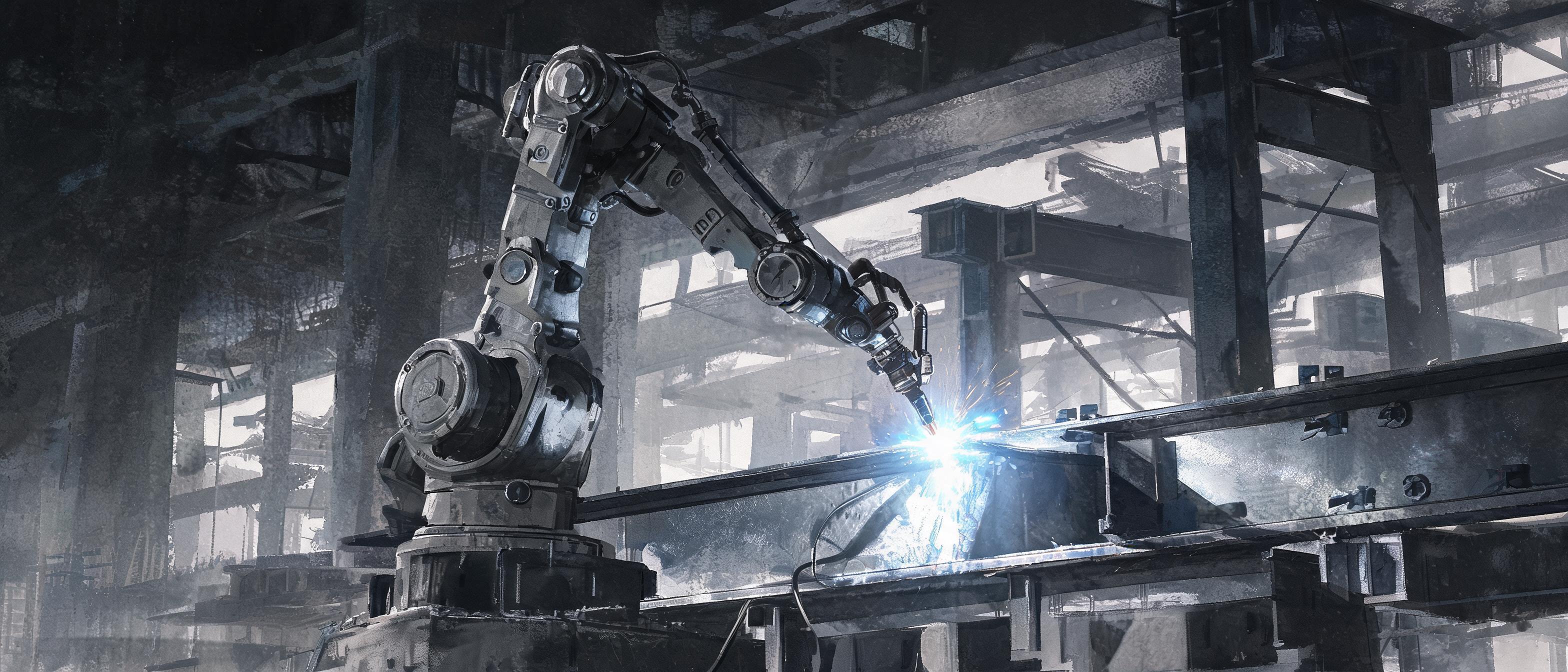
Researchers from Seoul National University, Georgia Southern University, and Chung-Ang University have proposed a lightweight post-training optimization framework designed to make construction-welding robots more reliable in reflective environments. The paper focuses on a practical obstacle for autonomous welding: metallic surfaces create glare, specular reflections, changing illumination, and thin seam geometries that can cause vision models to fragment or completely miss weld seams.
Rather than designing a larger neural network, the team started from an Online Hard Example Mining pretrained checkpoint and applied controlled fine-tuning with a hybrid Cross-Entropy–Lovász objective. The goal was to improve pixel-level classification, preserve seam continuity, and recover from reflection-induced segmentation failures without changing model architecture, parameter count, FLOPs, or inference latency.
The results were substantial for BiSeNetV2, a real-time segmentation model commonly considered suitable for resource-constrained robotic systems. Joint IoU increased from 59.40% to 81.76%, a gain of 22.36 percentage points, while mIoU reached 90.73%. The framework also recovered 96.33% of severe zero-IoU failure cases caused by strong reflections.
The researchers tested the method across several architectures, including U-Net, DeepLabV3+, SegFormer-B0, PIDNet-S, and BiSeNetV2. They found that the improvement was architecture-dependent: smaller real-time models such as BiSeNetV2 and PIDNet-S benefited consistently, while larger semantic-segmentation models showed smaller and less stable gains.
Robotic experiments validated the operational importance of better segmentation. The optimized BiSeNetV2 model was the only tested approach that consistently generated a valid weld-seam trajectory. It produced an average joint-center offset of 2.47 ± 0.78 mm during path planning, which the authors said represented an approximately 9.8× reduction compared with the previous BiSeNetV2-based robotic welding system.
The study argues that post-training optimization can be a computationally efficient alternative to redesigning perception models. For construction fabrication, that means more stable seam centerlines, fewer broken trajectories, and better robot reliability under the difficult lighting conditions typical of steel welding.