
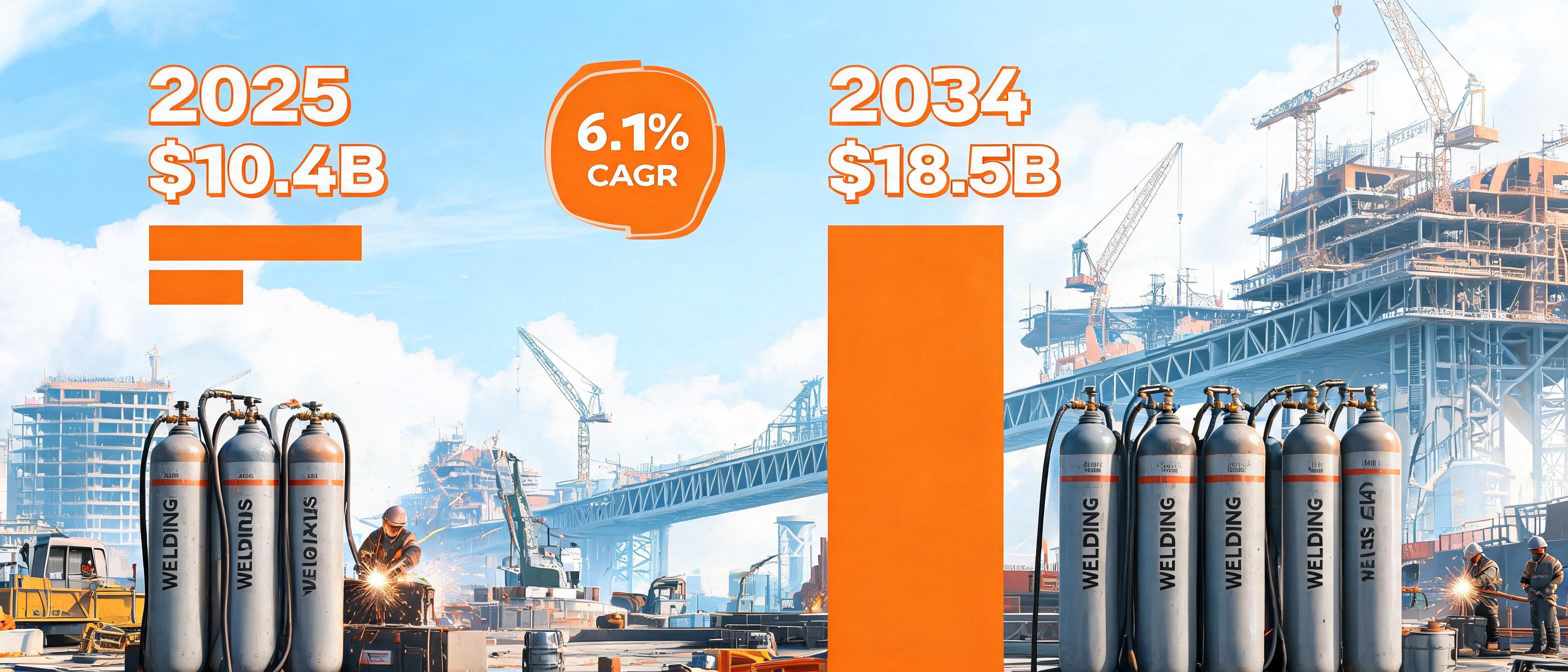
The global welding and cutting gases market was valued at USD 10.4 billion in 2025 and is projected to reach USD 18.5 billion by 2034, reflecting a compound annual growth rate of 6.1%, according to an industry market report published in August 2026.
Welding gases — primarily oxygen, acetylene, argon, carbon dioxide and helium — underpin a wide range of metal-joining and cutting techniques, from conventional oxy-fuel welding to advanced laser and plasma processes. Their purity, blend ratios and delivery technologies directly influence weld integrity, production speed and operating cost across the automotive, construction, shipbuilding, aerospace and energy sectors.
Industrial automation. The shift toward robotic welding lines has shifted demand toward premium, high-purity gases. Automation requires gases that deliver consistent arc stability and minimal oxidation, pushing suppliers to develop advanced formulations. Reported figures show the share of robotic-driven welds rose from 12% in 2021 to 18% in 2023, tightening the gas supply chain.
Infrastructure investment. Construction of data centers and high-speed rail networks continues to open weld-heavy markets. In Asia-Pacific alone, the merger of steel-frame housing with composite decking has proportionally increased demand for argon-helium blends, marking a new niche for gas distributors.
Sustainability and energy efficiency. Corporate ESG targets are pushing manufacturers to adopt gases that reduce carbon footprints. Lower-energy-consumption plasma generators now use inert gases blended with small proportions of nitrogen to curtail energy draw, producing a noticeable shift away from conventional argon-rich mixtures toward more efficient multi-gas blends.
The market faces several headwinds. Stricter classifications of welding gases as hazardous materials are tightening export controls, and divergent safety-data-sheet requirements across regions increase compliance costs and elongate time-to-market for new products. Recurring outages at key petrochemical hubs have caused price volatility that disturbs inventory strategies. An aging cohort of certified gas technicians has also led to higher-than-average turnover, forcing firms to invest in apprenticeship programs that are still under development.
High-purity gases carry a cost premium amplified by volatile alkyl-and-hydrogen feedstock prices, squeezing margins for mid-tier distributors. In North America, legislative caps on methane emissions are compelling operators to phase out methane-rich gases in favor of alternatives, requiring reformulation of welding lines and upfront capital outlays that many small-to-mid-size manufacturers find difficult to justify.
Smart gas management. Integration of IoT-based monitoring with gas delivery pipelines unlocks real-time consumption analytics. Early adopters report a 12% boost in process efficiency due to precise flow control, offering a differentiator in contract bidding. Gas suppliers that embed software platforms are forging deeper service agreements, converting commodity offerings into recurring revenue streams.
Circular economy. By establishing gas reclamation facilities, firms can recover residual gases, reducing procurement needs while aligning with sustainability agendas — an angle that resonates strongly with institutional investors.
Regional expansion. Recovery in the Middle East and North Africa, driven by expansion of offshore drilling rigs, opens fresh opportunities for high-flow argon and nitrogen blends. Distributors positioned at strategic logistics nodes are capitalizing on short-haul demand spikes.
Linde plc and Air Liquide dominate the global welding and cutting gases arena, operating production facilities across more than 70 countries and delivering over 70% of the world's supply of high-purity shielding gases. Their combined portfolios include specialty mixtures engineered for aerospace, shipbuilding and heavy-industrial fabrication, supporting long-term supply contracts with major OEMs and construction firms.
Air Products, headquartered in the United States, maintains a manufacturing network focused on high-volume oxygen, nitrogen and inert gas production, along with advanced gas-delivery systems supporting automation in robotic welding lines. Together, these three suppliers represent a consolidated market share exceeding half of global volume.
Regional manufacturers are expanding into niche segments and emerging markets. Germany's Messer Group and LoxTec GmbH have expanded into high-performance alloy welding gases tailored to automotive and energy applications. Japan's Taiyo Nippon Sanso Corporation leverages its expertise in helium-rich blends for precision aerospace work and has introduced low-cost recycled-argon streams. Germany's GEA AG is developing specialty gases for high-temperature plasma cutting.
By type, "gas for welding and cutting" drives core demand across industrial sectors, while protective gas supports advanced processes such as MIG and TIG. By application, machinery manufacturing remains the volume engine, feeding automotive, machinery and heavy-equipment production worldwide; aerospace pursues the highest-purity gases; shipbuilding and nuclear power demand robust blends for large-scale structural welding; and energy uses gases for pipeline and maintenance work.
By end user, original equipment manufacturers (OEMs) are the primary long-term partners relying on bulk deliveries; fabrication shops maintain steady project-based demand; and MRO providers extend the life of existing equipment and reduce downtime across the industrial supply chain.
_Report: 24ChemicalResearch, "Global Welding and Cutting Gases Market Research Report 2026–2033," August 2026._