
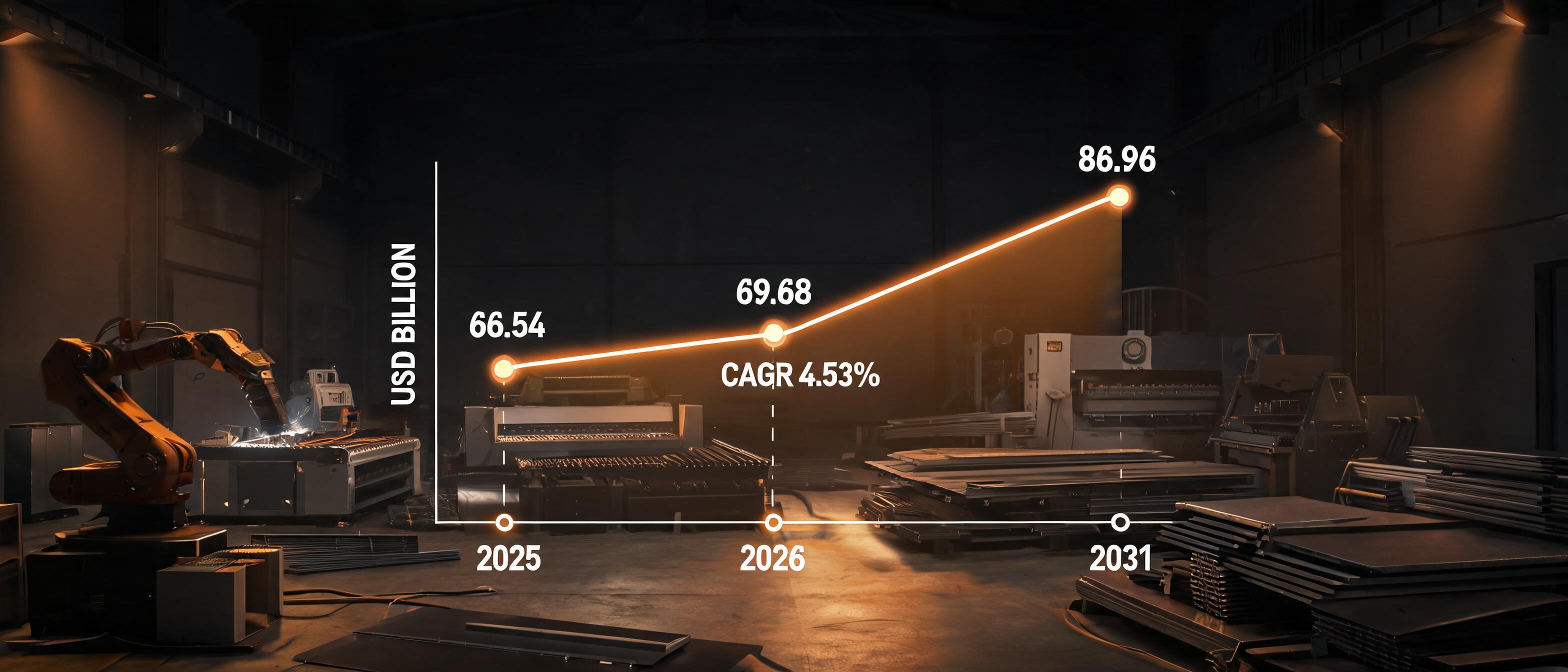
The Metal Fabrication Equipment Market size was valued at USD 66.54 billion in 2025 and is estimated to grow from USD 69.68 billion in 2026 to reach USD 86.96 billion by 2031, at a CAGR of 4.53% during the forecast period (2026-2031).
Robust capital spending in renewable-energy projects, vehicle electrification, and large-scale infrastructure upgrades underpins this steady expansion. Vendors supplying high-power fiber-laser cutters, servo-press brakes, and integrated robotic welding cells are benefiting from shorter product-refresh cycles in automotive plants, the boom in offshore wind towers, and the need to machine recycled alloys with unpredictable carbon content. Equipment purchases are also moving closer to end-markets as manufacturers reshore heavy fabrication to reduce logistics risk and comply with domestic-content rules. Meanwhile, rising cybersecurity threats and raw-material price swings continue to influence procurement timing, pushing buyers to favor machines that include predictive-maintenance software and remote-patch capabilities.
- By equipment type, machining captured 30.56% of 2025 revenue; cutting systems are projected to post the fastest 6.78% CAGR to 2031.
- By end-user industry, automotive held 31.45% of 2025 demand, while energy and oil-and-gas applications are set to expand at a 7.56% CAGR through 2031.
- By geography, Asia-Pacific commanded 46.76% of 2025 revenue; the Middle East and Africa region is forecast to grow at a 6.23% CAGR to 2031.
- Trumpf, Amada, DMG MORI, and Yamazaki Mazak together accounted for 42% of global 2025 sales.
Growing automotive production & model refresh cycles (+1.2% impact). Automakers are compressing model-refresh intervals from seven to under four years, driving frequent retooling of press lines, laser cutters, and robotic welding cells. North American battery-electric vehicle plants now specify up to twelve servo presses and multiple fiber-laser blanking systems for each new platform. Tier-1 suppliers report that every one million incremental battery-electric cars requires about 240 CNC machining centers and 320 robotic welding stations.
Expanding construction & infrastructure investments (+1.0%). Megaprojects across Saudi Arabia, India, and Indonesia necessitate heavy-duty press brakes, waterjet cutters, and automated submerged-arc welders to meet compressed commissioning schedules. NEOM alone will consume more than 26 million metric tons of fabricated steel by 2030, requiring on-site plate-forming and laser-cutting capacity.
Rising demand from aerospace manufacturing (+0.8%). Firm backlogs at Airbus and Boeing secure nine years of production, compelling their supply chains to lock in capacity for titanium bulkheads and Inconel engine mounts. Five-axis machining centers with envelope sizes above one meter are now standard in turbine-blade shops, while laser-weld cells deliver porosity below 0.5% in fuel-tank structures.
Near-shoring of heavy-fabrication supply chains (+0.7%). U.S. reshoring announcements surged 78% year-on-year in 2024, and each USD 1 billion of relocated fabrication creates equipment demand worth nearly USD 180 million. Mexican press-brake distributors enjoy record backlogs as U.S. buyers diversify away from Asian imports.
- Volatile raw-steel & non-ferrous prices (-0.9%): Hot-rolled coil steel fluctuated between USD 650 and USD 950 per metric ton in 2024. Aluminum tracked a 31% price swing.
- High cap-ex requirement for next-gen CNC systems (-0.7%): Five-axis machining centers list above USD 500,000, exceeding the capital ceiling of 62% of North American job shops. Advanced fiber-laser systems above 8 kW cost up to USD 1.8 million.
- Shortage of skilled welders & machinists (-0.6%).
- Cyber-security risk in connected machine tools (-0.4%).
Machining retained the largest 30.56% metal fabrication equipment market share in 2025. Meanwhile, cutting systems are forecast to expand at a 6.78% CAGR to 2031, marking the highest pace within the market. Fiber-laser platforms above 8 kW deliver cut speeds surpassing 100 meters per minute on 3-millimeter mild steel, offering a 40% throughput edge over plasma while producing heat-affected zones under 20 microns.
Welding and joining lines transition toward fiber-laser and friction-stir processes to meet porosity limits in battery housings and LNG cryogenic tanks. Across all categories, automation modules such as robotic load/unload, in-process metrology, and vision-guided seam tracking differentiate offerings.
Automotive accounted for a commanding 31.45% of 2025 demand, yet the fastest-growing customer group is energy and oil-and-gas, projected at a 7.56% CAGR through 2031. Floating LNG modules, subsea manifolds, and offshore wind towers require heavy-plate rolling, high-current submerged-arc welding, and robotic cladding of corrosion-resistant alloys.
Asia-Pacific captured 46.76% of global 2025 revenue. The Middle East and Africa region will log the fastest 6.23% CAGR through 2031, led by Saudi Arabia's USD 500 billion NEOM procurement. North America's second reshoring wave produced a 78% surge in announced relocations during 2024. Buyers prioritize machines with remote monitoring compliant with IEC 62443 to mitigate ransomware risk.
In the European Union, Regulation (EU) 2023/1230 on machinery replaces the prior Machinery Directive and becomes mandatorily applicable from 20 January 2027, adding explicit attention to digital instructions, cybersecurity, and criteria around substantial modifications. In the United States, OSHA requirements include 29 CFR 1910.217 (mechanical power presses) and 29 CFR 1910.218 (forging machines). ISO 15608:2025, published in October 2025, updates the uniform grouping system for metallic materials used in welding, heat treatment, and NDT planning.
Incumbent leaders Trumpf, Amada, DMG MORI, and Yamazaki Mazak jointly held 42% of 2025 global revenue. Trumpf's TruConnect suite links lasers, press brakes, and storage towers into one dashboard, reducing programming time by 30%. DMG MORI's CELOS X platform packages predictive maintenance on a subscription.
Strategic M&A consolidates automation expertise. Lincoln Electric's USD 230 million purchase of Baker Industries adds turnkey integration to its welding portfolio, while Bystronic's buyout of Swiss automation firm Antil introduces robotic palletizing to its high-power laser cutters. Vendors able to pair edge-AI optimization with secure connectivity position themselves to capture growth across reshoring and renewable-energy expansions.
White space is most visible where fabricators need measurable throughput gains but cannot staff around skilled-labor constraints. Samsung Heavy Industries commissioned an automated Pipe Robofab facility (6,500 square meters, 100,000 piping spools per year) using AI-driven vision and robotics. Novarc Technologies launched NovAI Autonomy and the NovHub platform to enable real-time, vision-based adaptation for robotic welding on ABB and Yaskawa systems.