
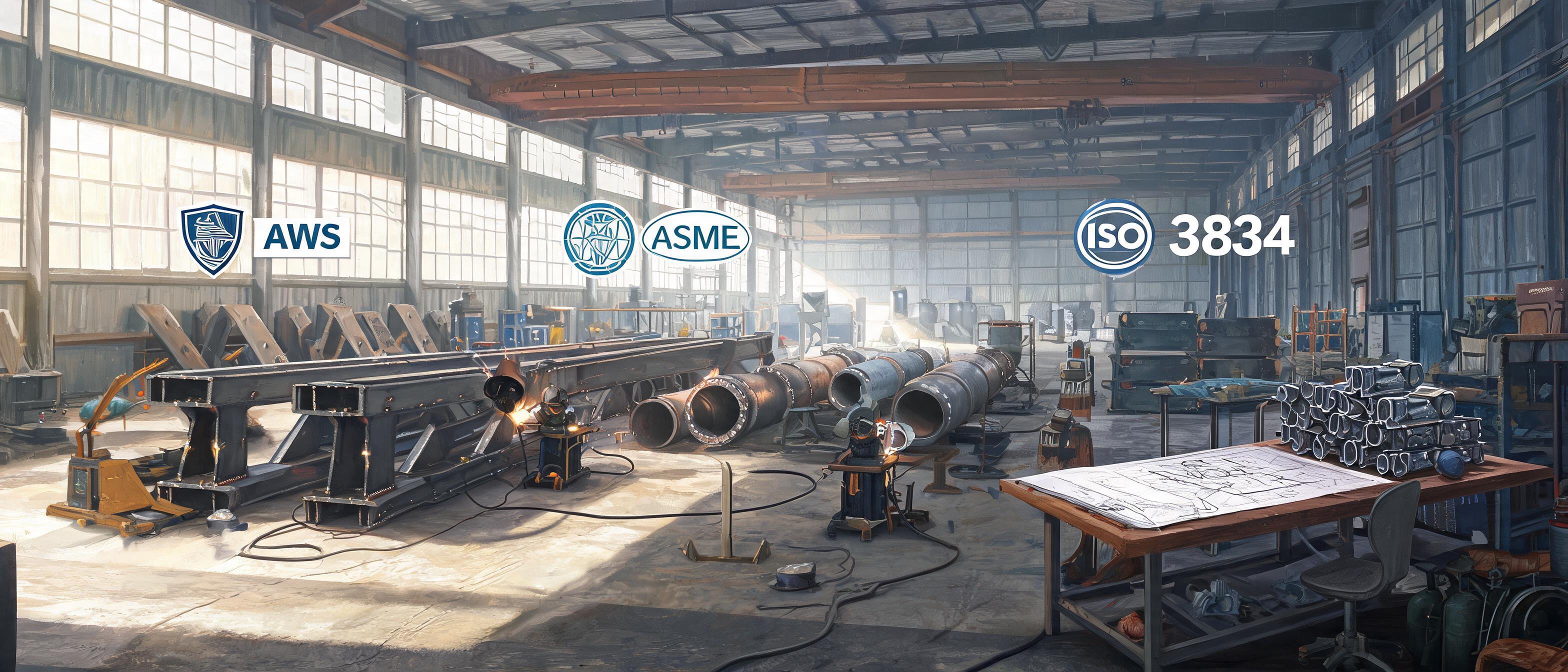
Walk into most fabrication shops and welding operations and you'll find references to multiple welding standards on the same job — AWS D1.1 procedures on the structural steel, ASME Section IX qualifications for the pressure piping, and ISO 3834 requirements from a European customer's purchase order. These aren't alternatives to each other. They govern different applications, address different risk categories, and in many operations apply simultaneously to different work being performed in the same facility.
Understanding which standard governs which application — and what each actually requires — is the difference between a qualification program that holds up under audit and one that generates major nonconformances when an auditor asks to see the PQR for the weld currently in progress.
Under ISO 9001 Clause 8.5.1, welding is classified as a special process — a process whose output cannot be fully verified by subsequent inspection or measurement alone. A completed weld joint may look visually acceptable while containing internal defects — incomplete fusion, porosity, cracks — that only become apparent under load or through destructive testing. Because quality cannot be inspected in after the fact, it must be controlled during the process itself. This drives the three core requirements that all welding standards share in some form:
- Qualified procedures — the welding process must be validated through testing before production begins. The Welding Procedure Specification (WPS) documents the variables; the Procedure Qualification Record (PQR) documents the testing that validates the WPS.
- Qualified personnel — the welder performing the work must be qualified by test to the variables they'll be working within. The Welder Performance Qualification (WPQ) documents this.
- Controlled process parameters — during production, the variables that affect weld quality must be monitored and controlled. Deviating from qualified variables without re-qualification is a nonconformance under every welding standard.
This framework is universal. What differs between AWS, ASME, and ISO is which specific variables are essential, what tests are required for qualification, and what the acceptance criteria are.
AWS D1.1/D1.1M is the primary welding code for structural steel applications — the standard referenced on most structural fabrication drawings and contracts in the United States. It applies to statically and dynamically loaded structures: buildings, bridges, cranes, industrial equipment supports, and structural assemblies, for steel with minimum yield strength up to 100 ksi.
One of D1.1's most practically significant features is its library of prequalified joint designs — joint configurations approved for use without a PQR qualification test. If your joint design matches a prequalified configuration and your welding variables fall within the prequalified ranges, you can use a prequalified WPS without running a qualification test weld. However, prequalified status has limitations — base metal type, filler metal specification, preheat minimums, and joint geometry all have specific constraints. Using a prequalified WPS outside its parameters invalidates the status.
For joints that are not prequalified, a full WPS with supporting PQR is required. Essential variables under AWS D1.1 include process, base metal specification and group, filler metal classification, position, joint design, preheat and interpass temperature, post-weld heat treatment, and electrical characteristics. Welders must be qualified by test for each process, position combination, and base metal group; qualifications remain valid as long as the welder maintains continuity of use. AWS also publishes parallel D1.x codes for aluminum (D1.2), stainless steel (D1.6), and a seismic supplement (D1.8).
ASME BPVC Section IX is the foundational qualification standard for all pressure system welding — the legally mandated framework (via state and local law in most U.S. jurisdictions) for pressure vessels, boilers, heat exchangers, process piping, and nuclear components. The most important concept is essential variables: welding parameters whose change requires re-qualification of the WPS through a new PQR. Key essential variables include base metal P-number grouping, filler metal F-number classification, post-weld heat treatment application, shielding gas composition, and position.
Every production weld on a pressure-containing system must use a qualified WPS supported by a PQR documenting all actual welding variables and mechanical test results. Tension tests and guided bend tests are required for most PQRs; Charpy impact tests are required as supplementary essential variables when impact toughness is specified.
A notable difference from AWS: ASME Section IX qualifications expire if the welder has not used the qualified process within 6 months. This continuity requirement is a consistent source of audit findings in shops that perform both structural (AWS) and pressure (ASME) work — welders active on structural work may let their ASME qualifications lapse without realizing it.
ISO 3834 is the international welding quality standard, providing a framework that complements ISO 9001 where welding is a primary manufacturing process. It has three conformity levels: Comprehensive (ISO 3834-2) for safety-critical, complex, or high-risk welding; Standard (ISO 3834-3) for general industrial applications; and Elementary (ISO 3834-4) for simple, low-risk operations. ISO 3834 goes deeper than ISO 9001 into welding-specific quality management — contract review, subcontracting controls, personnel qualification, equipment maintenance and calibration, production planning, joint preparation and dimensional inspection, pre-production testing, heat treatment controls, and post-weld inspection. It is typically required by European customers, the EU Pressure Equipment Directive (PED), and export-driven fabrication.
ISO 9606 covers welder performance qualification, with separate parts by base material: steels (Part 1), aluminum (Part 2), copper (Part 3), nickel (Part 4), and titanium (Part 5). ISO 9606 qualifications are not interchangeable with AWS D1.1 or ASME Section IX qualifications — organizations serving both North American and international customers may need separate qualification records for each framework.
ISO 15614 is the ISO standard for welding procedure qualification — the ISO equivalent of ASME Section IX PQR testing — defining essential variables, test requirements, and acceptance criteria, with multiple parts covering different processes and base materials, including arc welding of steels and nickel alloys (Part 1) and aluminum (Part 2).
The most dangerous word in a fabrication environment is "assumed" — assumed we were working to AWS, assumed the AISC tolerances applied, assumed the customer would accept the deviation. Every time those words are spoken, there is rework behind them. The fix requires discipline at the front end of every project: before production begins, the applicable standard for every work scope must be identified, documented, and communicated to the production team. Job specifications must be read completely — not summarized. The five minutes spent confirming which standard governs a particular inspection activity can save days of rework and thousands of dollars in a single project.