
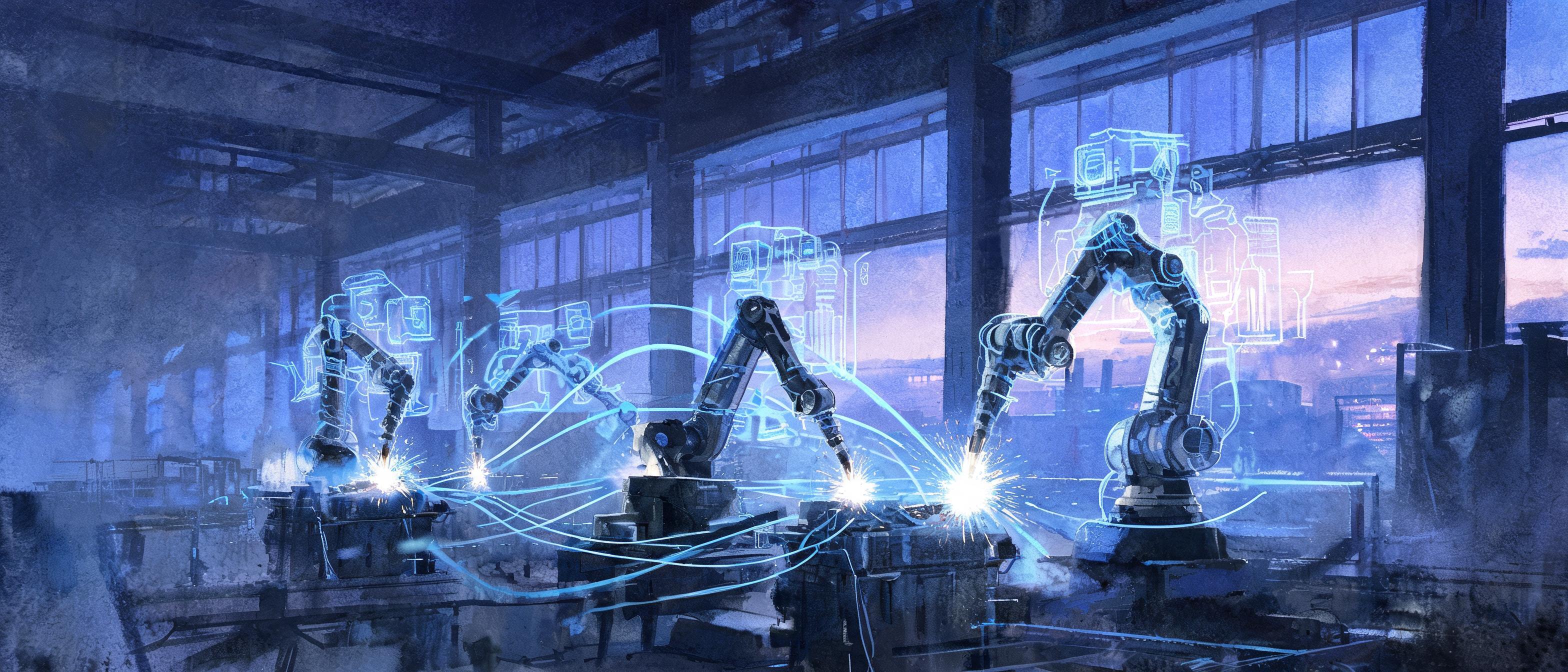
Welding automation is evolving fast — from AI-driven adaptive welding to data-first service models and digital twins, manufacturers must move from isolated robot cells to connected, learning systems. Pemamek identifies five trends shaping welding automation in 2026:
1. AI & adaptive welding: machines that learn while they weld. Adaptive welding and closed-loop control use sensors and machine learning to adjust welding parameters in real time, reducing rework and enhancing first-pass yield while making complex joints more automatable. The lack of skilled welders is the main driver pushing manufacturers toward automation, alongside rising quality demands, stricter tolerances and the need to minimize scrap. Improvements in sensors, computing power and industrial AI libraries have made adaptive algorithms practical outside labs — for heavy fabrication, every rework hour is expensive, and adaptive welding means fewer rejects and faster ramp-up on new parts.
2. Digital twins & virtual commissioning: commissioning before the crane arrives. Digital twins, virtual commissioning and offline simulation let integrators fully validate robot trajectories, tooling and PLC logic before hardware reaches the site, and remote factory acceptance testing (FAT) is increasingly feasible. Project teams can discover clashes, optimize cycles and reduce unexpected delays, delivering faster, safer start-ups with lower installation risk and total cost of ownership for large cells.
3. Laser & hybrid welding: speed and precision moving into heavy fabrication. Laser-arc hybrid welding is moving from high-precision work into heavier applications where travel speed, low heat input, minimal pass count and minimal distortion matter. Hybrid processes combine the penetration of laser with the fill and robustness of arc, opening opportunities for narrower heat-affected zones, faster travel speeds and new joint designs previously too risky or slow for heavy fabricators — especially in wind, shipbuilding and structural steel.
4. Data-driven service models: from one-off sales to up-time guarantees. Manufacturers are increasingly buying outcomes — uptime, throughput and predictable quality — rather than just machines. Predictive maintenance, remote monitoring and spare-parts subscription models turn service into a strategic, recurring revenue stream. For heavy automation, even a single day of unexpected downtime can be hugely costly, making data-driven service agreements that convert capital equipment into managed production assets with measurable KPIs increasingly attractive.
5. Workforce shifts & upskilling: people and automation, not people versus machines. The skilled welder shortage and the need for digital-savvy operators are reframing workforce strategies. Roles are shifting toward automation supervision, maintenance and process management. Demographics, talent competition and the increasing complexity of automated systems require companies to invest in training, remote support and intuitive interfaces — adoption stalls if the workforce cannot operate and maintain new systems.
The future of welding automation is less about isolated robot cells and more about connected, intelligent systems that deliver measurable outcomes: less rework, faster ramp-up, higher uptime and lower total cost of ownership.