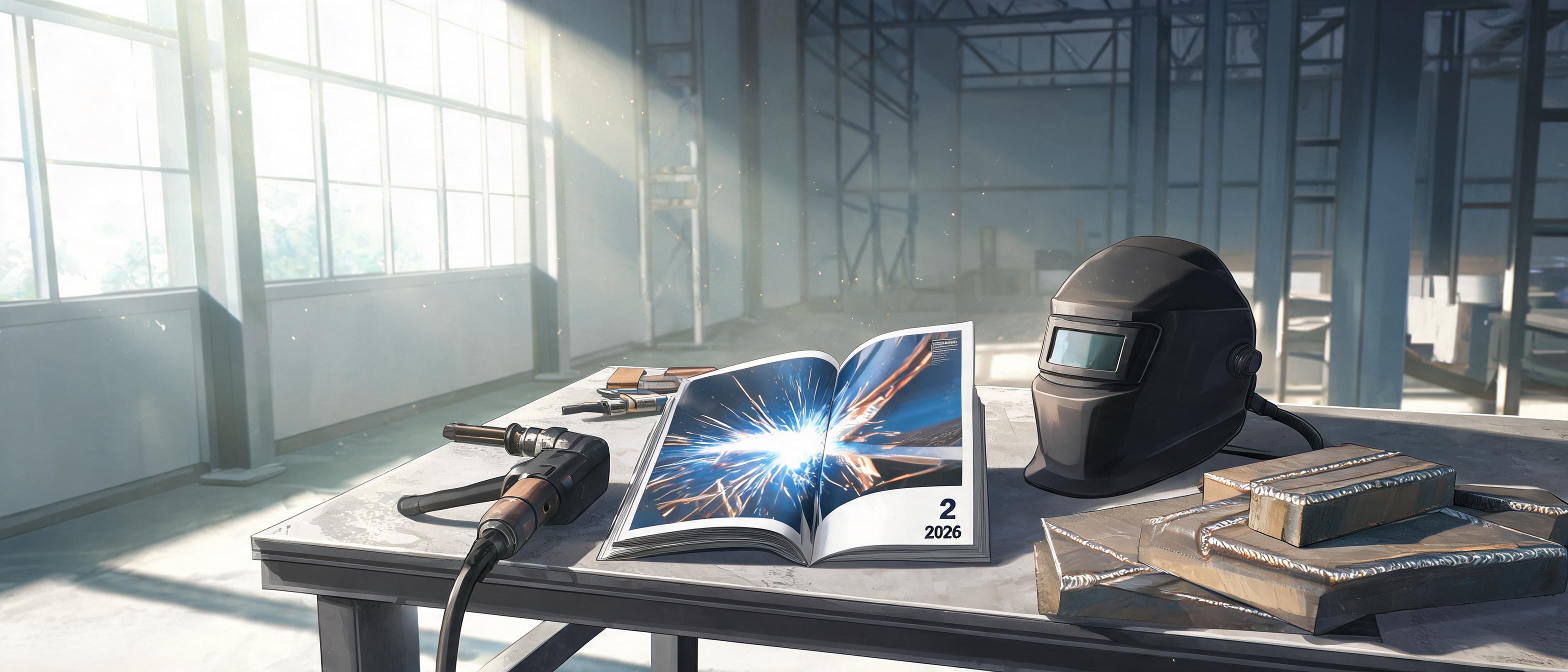
WELDING AND CUTTING, a peer-reviewed international trade journal editorially focused on welding, cutting and brazing/soldering technology and its related disciplines, has released Issue 2 of 2026. The journal features regular and comprehensive reports from the industry, science and practice fields of the welding technology sector, highlighting both new developments and economic issues for expert readers worldwide. The new issue contains 24 articles across cover stories, news, company features, interviews, reports and specialist technical papers.
The editorial team spotlights several lead stories for Issue 2 (2026). SCHWEISSEN & SCHNEIDEN will present itself at the EURO DEFENCE EXPO (EUDEX) joint stand, held for the first time at Messe Essen from 22 to 25 September 2026, as the exhibition grounds place a stronger focus on the security and defence industry.
Technical features include a report on quality assurance for gas metal arc welding during the welding process, profiling Lessmüller Lasertechnik GmbH of Munich, a manufacturer of quality monitoring systems that is expanding into automated weld seam inspection for gas metal arc welding. An education-focused article presents the ArcLess Academy approach as a practical pedagogical model in welding education, combining visualisation, digital learning and iterative skill development.
News pages cover an EU directive revision to better protect workers from hazardous substances; the election of Stephan Egerland as new President of the IIW — International Institute of Welding; new leadership at the IFR — International Federation of Robotics; and the EWF's announcement of the 3rd edition of its Professionals of the Future event.
Company stories include a feature on Fronius and Hargassner as two Austrian pioneers of the energy transition; Yaskawa's opening of a new robot distribution centre in Slovenia; a look at how new depreciation rules create additional investment incentives for modern manufacturing technology; an auto-darkening helmet bringing natural colour visibility to welders; and the critical role of gas supply in automated welding.
Peer-reviewed specialist papers in the issue cover a range of joining topics, including pulsed laser beam welding of duplex steel; flux-cored wires in industrial welding applications; brazing properties of novel Fe-based amorphous brazing foils for joining steel; and geometric and dynamic factors that govern torch control in orbital TIG welding. A separate report details a new assistance system that simplifies robotic wire arc additive manufacturing (WAAM), reflecting the journal's coverage of automation and additive processes.