
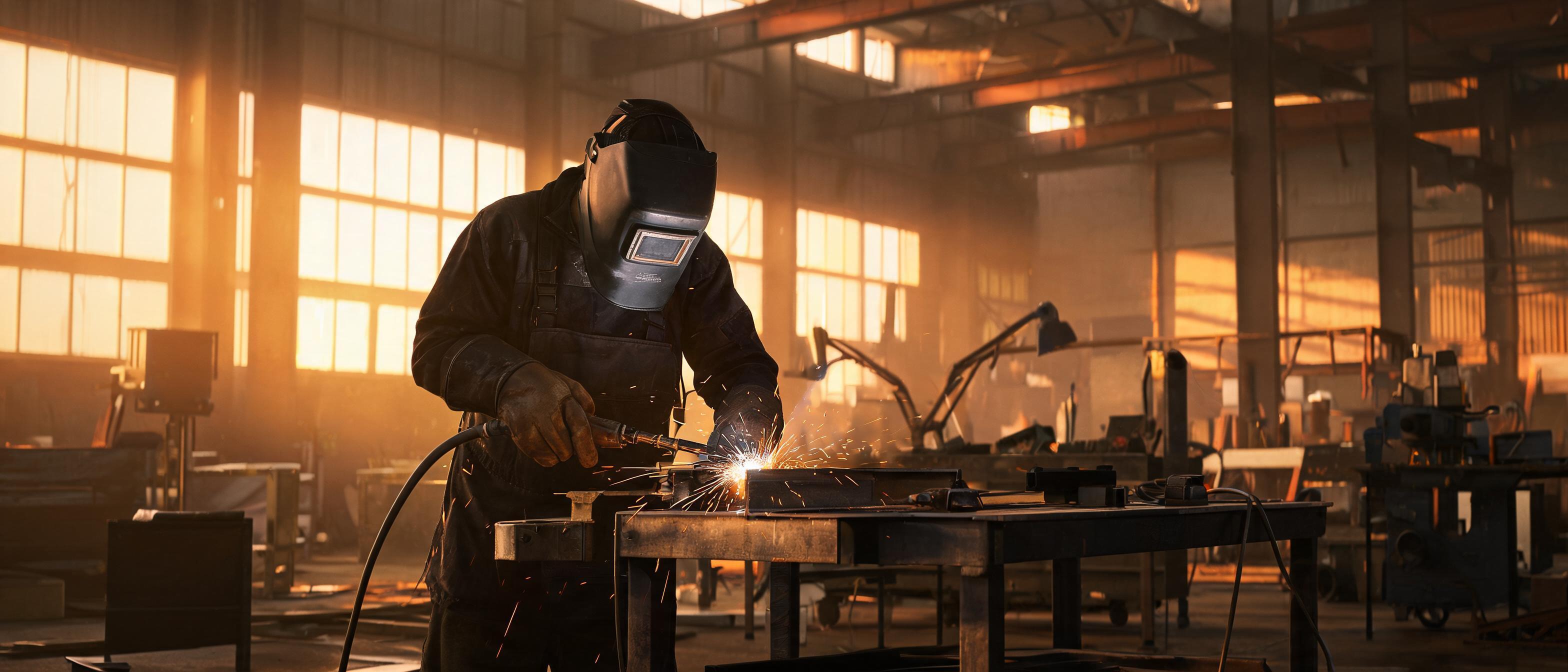
From 1 July 2026, Section 26A of the WHS Act makes compliance with Safe Work Australia's Code of Practice: Welding Processes legally binding, creating a standalone offence for failure to follow it. The code establishes a comprehensive framework for managing hazards across all welding, thermal cutting, brazing, soldering and allied processes — MIG, TIG, stick, flux-cored, submerged arc, oxy-fuel, plasma cutting and laser welding — covering fume and gas management, ventilation and extraction, fire and explosion prevention, electrical safety, radiation protection, noise, PPE, hot work permit systems and confined space welding.

The code applies to every PCBU whose workers perform welding, cutting or allied thermal processes: metal fabrication shops, construction companies doing site welding, auto body repair shops, maintenance workshops, mining operations, manufacturers with in-house welding, and any business engaging welding contractors. It also extends to designers and manufacturers of welding equipment and to consumable suppliers, who must provide safety data sheets with accurate fume composition information.

Businesses must assess fume and gas hazards for each welding process based on base metal, consumable, shielding gas and parameters. Local exhaust ventilation with source capture is the primary engineering control — general ventilation alone is insufficient for most indoor welding, and extraction must capture fume within the worker's breathing zone. Hot work permits are required for all welding outside designated bays, with fire watches maintained after work ceases. Confined space welding needs forced ventilation, continuous atmospheric monitoring and emergency rescue provisions, while radiation protection requires welding screens to shield nearby workers from UV exposure.

  1. Conduct fume exposure monitoring at all welding workstations for total fume and speciated metals (manganese, hexavalent chromium, nickel) against the current 1 mg/m³ fume WEL and the incoming individual metal WELs effective December 2026.
  2. Audit local exhaust ventilation on all welding bays using smoke tube testing and capture velocity measurements.
  3. Review hot work permit systems for welding outside designated bays, verifying fire risk assessments and fire watch documentation.
  4. Update welding SWMS and procedures to reference the binding code and incoming WELs.
  5. Verify health surveillance programs cover all welders with lung function testing, audiometric testing and monitoring for metal-specific effects such as manganism and chromium sensitisation.

Welding fume is an IARC Group 1 carcinogen, and inadequate fume control exposes workers to a known cancer risk. Category 2 penalties of up to $2,235,363 for a body corporate apply where workers are exposed to excessive welding fume through inadequate extraction or ventilation. The concurrent WEL reductions — manganese down 98%, nickel down 99%, hexavalent chromium down 90% — add further enforcement exposure for businesses that have not upgraded extraction and monitoring. Improvement notices are commonly issued for workshops without local exhaust ventilation, non-compliance with such notices is a separate offence, and all penalties are uninsurable in NSW since 10 June 2020.

More Industry News

Policy & Standards

01
Policy & Standards
Safe Work Australia Welding Processes Code of Practice becomes legally binding July 1, 2026
From July 1, 2026, Safe Work Australia's Code of Practice for Welding Processes is legally binding under Section 26A of …
EHS Atlas·September 11, 2026
Read more
02
Policy & Standards
Australia welding fume regulation changes: lower exposure limits and new extraction requirements
Australia cut welding fume limits to 1 mg/m3 in November 2025, with further Workplace Exposure Limit reductions for mang…
Apex Welding Safety·September 11, 2026
Read more
03
Policy & Standards
New international welding standards arriving in 2026, including EN ISO 18491:2026 on arc energy measurement
2026 brings new international standards including EN ISO 18491:2026 for measuring arc energies in welding, supporting qu…
iTeh Standards·September 11, 2026
Read more
04
Policy & Standards
OSHA 2026 safety updates: what welding employers need to know
A rundown of 2026 OSHA safety updates affecting welding and cutting operations, covering training requirements, hot work…
Abolox·September 11, 2026
Read more
05
Policy & Standards
ANSI Z49.1 remains the benchmark for welding and cutting safety in 2026
ANSI Z49.1 continues to serve as the industry benchmark for safety in welding, cutting and allied processes, covering PP…
ANSI Blog·September 11, 2026
Read more
06
Policy & Standards
Welding fume exposure deep dive 2026: compliance with tighter exposure limits
A 2026 deep dive into welding fume exposure risks and compliance strategies, covering local exhaust ventilation, respira…
SmartQHSE·September 11, 2026
Read more

Top Headlines

07
Top Headlines
NFPA 51B hot work fire prevention: fire watch and permit requirements for welding and cutting
NFPA 51B outlines responsibilities for fire prevention during welding, cutting and other hot work, including removal of …
NFPA·September 11, 2026
Read more

Technology & Automation

08
Technology & Automation
2026 marks a new phase in autonomous robotic welding
Valk Welding describes 2026 as a new phase for autonomous robotic welding, with AI-driven product recognition eliminatin…
Valk Welding·September 11, 2026
Read more
09
Technology & Automation
AI-powered grinding robot automates weld seam preparation
AI-powered grinding robots can now create and finish weld bevels automatically, generating machining programs from geome…
Read more
10
Technology & Automation
Smart manufacturing in metal fabrication 2026: industry transformation guide
Metal fabrication in 2026 is experiencing a technological renaissance, with smart machines, robotic welding, cobots and …
MIE Solutions·September 11, 2026
Read more
11
Technology & Automation
Emerging trends for 2026 in the metal fabrication industry
2026 metal fabrication trends include AI-powered seam tracking, collaborative welding robots for SMEs, and high-power fi…
Machitech·September 11, 2026
Read more
12
Technology & Automation
Summer 2026 M&A report in the metal fabrication industry sector
Private equity funds remain active in metal fabrication M&A with buy-and-build strategies, targeting automation solution…
Corporate Finance Associates·September 11, 2026
Read more

Market & Industry

13
Market & Industry
Why metal fabrication remains a dynamic business in 2026
The Fabricator outlines why metal fabrication remains dynamic in 2026, citing automation adoption, digitalization, advan…
The Fabricator·September 11, 2026
Read more
14
Market & Industry
Welding trends 2026: distribution consolidation and acquisition activity
Regional welding supply distribution continues consolidating in 2026, with Meritus Gas Partners' Buckeye Welding Supply …
Meritus Gas Partners·September 11, 2026
Read more
15
Market & Industry
Welding equipment market forecast to grow at 10.7% CAGR through 2033
The welding equipment market is forecast to reach USD 50.82 billion by 2033 at a 10.7% CAGR from 2026, driven by automat…
Coherent Market Insights·September 11, 2026
Read more
16
Market & Industry
Welding consumables market growth across key economies
The global welding consumables sector is anticipated to grow from USD 21.4 billion in 2026 to USD 36.9 billion by 2036 a…
OpenPR·September 11, 2026
Read more

Events & Conferences

17
Events & Conferences
American Welding Society announces 2026 conferences, including Inspection Expo with AI focus
AWS announced its 2026 conference lineup, headlined by the Inspection Expo & Conference on welding inspection and AI in …
Automation.com·September 11, 2026
Read more
18
Events & Conferences
AWS Welding Automation Exposition & Conference set for June 2026 in Minneapolis
The American Welding Society's Welding Automation Exposition & Conference, June 2-4, 2026 in Minneapolis, focuses on inn…
American Welding Society·September 11, 2026
Read more